- Download the worksheet to save time writing
- Start solving the practice problems
- If you're stuck, watch the video solutions
- See your summary to get more insights

Suppose an 800-gram object is initially at point O on a potential energy diagram. The particle is initially at rest, and the diagram illustrates the variation in potential energy as the particle moves from O to P, and Q. Determine the speed of the particle when it passes through points (i) P and (ii) Q.

The figure shows the potential energy with respect to the position of an object undergoing oscillatory motion between x = 1.0 mm and x = 5.0 mm. With a mass of 4.0 g, what is the maximum speed that this object can achieve?

A single particle is moving in an environment that is characterized by a potential energy graph shown in the figure below. Determine the x-component of the force (magnitude and direction) acting on the particle when it is positionedat (i) x = 3 cm, (ii) 6 cm, and (iii) 10 cm along its path.

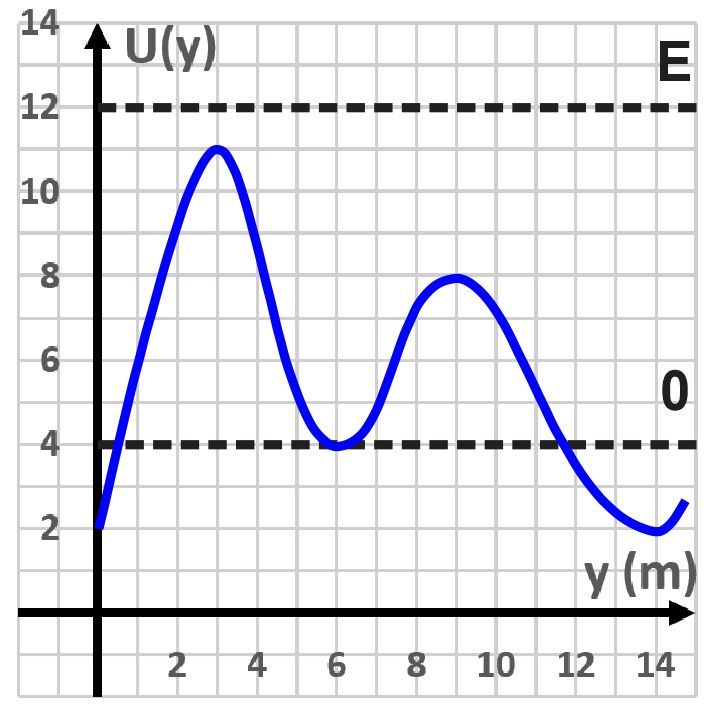
As a result of a conservative force acting parallel to the y-axis on an object, it moves along the same axis. Its energy versus the y-axis graph is given in the figure below. In the graph, it can be seen that the total energy E > U(y), which implies the speed of the object is always non-zero. Find the y values at which the force magnitude is a minimum.