- Download the worksheet to save time writing
- Start solving the practice problems
- If you're stuck, watch the video solutions
- See your summary to get more insights

A group of scientists are conducting some research on the Earth's atmosphere and need to place a satellite in an orbit that will allow them to observe a specific region of the planet. To achieve this, they decide to place the satellite in a geostationary orbit, which is an orbit that keeps the satellite above a fixed point on the Earth's equator as it rotates. The altitude of the geostationary orbit they have chosen is approximately 22,236 miles. What is the period of the satellite's orbit in this geostationary position?
Provide your answer in SI units and refer to any necessary astronomical data
As a space industry consultant, you want to launch satellites around a planet of unknown mass and a radius of 1.35 × 10⁸ m. An existing satellite of mass 240 kg orbits the planet with an orbital speed and radius of 9449 m/s and 6.50 × 10⁸ m respectively. The satellite you wish to launch has a mass of 305 kg and the desired orbital radius is 2.05 × 10⁸ m. Determine the orbital speed that you should provide the satellite with.
An observer on Earth notes that a satellite makes 21.96 revolutions around Mars every week. What is the height of its orbit above Mar's surface assuming a round orbit?
On February 9, 2009, United States and Russian satellites collided in orbit 790 km above the earth's surface producing thousands of debris. Assuming a circular orbit, what was the orbital period of the two colliding satellites?
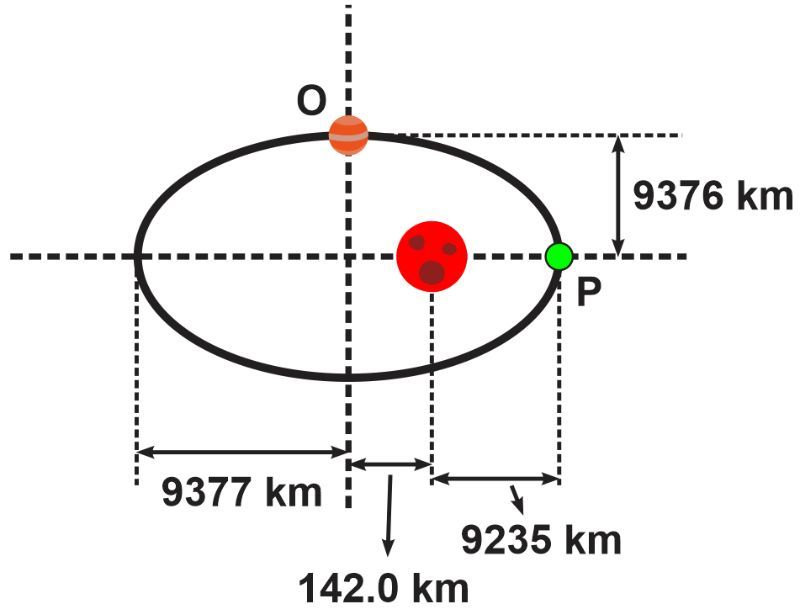
The Martian moon ''Phobos'' orbits Mars in an ellipse, as shown in the figure. At the periapsis (the closest distance from Mars), it moves at 2138 m/s. Utilizing the law of conservation of energy, calculate its speed at point O.
[Take the mass of Mars as 6.4 x 10²³ kg]
An asteroid orbits a distant planet in an ellipse, asshown in the figure below. Astronomers estimated its speed at the periapsis to be 3630 m/s. Taking the mass of the planet equal to 7.50 x 10²³ kg, apply the law of conservation of energy to find the value of its speed at the apoapsis, marked by point O.