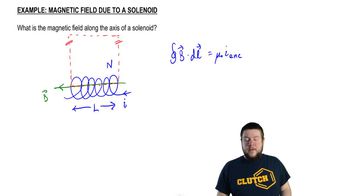
What does Ampere's Law relate in terms of magnetic fields and electric currents?
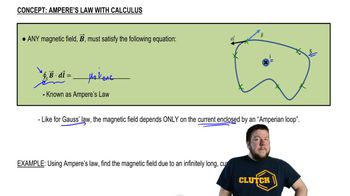
Ampere's Law relates the line integral of the magnetic field B around a closed loop to the product of the permeability of free space (mu_0) and the current enclosed by the loop.
What does the circle on the integral sign in Ampere's Law indicate?
The circle indicates that the integral is taken over a closed loop, called an Amperian loop.
What is the mathematical expression of Ampere's Law?
The mathematical expression is the closed line integral of B dot dl equals mu_0 times the enclosed current (∮B·dl = μ₀I_enclosed).
What is an Amperian loop?
An Amperian loop is a closed path along which the magnetic field is integrated in Ampere's Law.
How is the direction of the magnetic field around a current-carrying wire determined?
The direction is determined using the right-hand rule: point your thumb in the direction of the current, and your fingers curl in the direction of the magnetic field.
What does the differential line element dl represent in Ampere's Law?
The dl represents an infinitesimal segment that is tangential to the curve of the Amperian loop at each point.
When applying Ampere's Law to a circular loop around a wire, why is the dot product B·dl simplified?
It is simplified because the magnetic field B and dl are always parallel along the loop, making the dot product equal to just B dl.
Why can the magnetic field B be taken out of the integral when using a circular Amperian loop around a wire?
Because the magnetic field is constant in magnitude at every point along the circle due to symmetry.
What is the value of the line integral ∮dl around a circle of radius r?
The value is the circumference of the circle, which is 2πr.
What is the formula for the magnetic field at a distance r from an infinitely long straight wire using Ampere's Law?
The formula is B = μ₀I / (2πr).
How does Ampere's Law compare to the Biot-Savart Law for finding the magnetic field of a long straight wire?
Ampere's Law provides a much quicker and simpler method than the Biot-Savart Law for this scenario.
What does Ampere's Law depend on when calculating the magnetic field?
It depends only on the current enclosed by the chosen Amperian loop.
How is the application of Ampere's Law similar to Gauss's Law?
Both use closed paths (loops or surfaces) and relate the field integral to the enclosed source (current for Ampere, charge for Gauss).
What must you know about the magnetic field before applying Ampere's Law effectively?
You must know the symmetry and direction of the magnetic field around the current, often using the right-hand rule.
What is the physical meaning of the line integral ∮B·dl in Ampere's Law?
It represents the total 'circulation' of the magnetic field around the closed loop, which equals μ₀ times the enclosed current.
 Back
Back
 05:21
05:21