How do you calculate the cross product of two vectors using their components in unit vector notation?
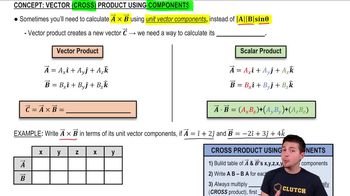
To calculate the cross product of two vectors A and B using their components, express A = (Ax i + Ay j + Az k) and B = (Bx i + By j + Bz k). The cross product C = A × B is a vector with components:
Cx = Ay Bz − By Az
Cy = Az Bx − Bz Ax
Cz = Ax By − Bx Ay
So, C = (Ay Bz − By Az) i + (Az Bx − Bz Ax) j + (Ax By − Bx Ay) k.
Why can't you use the formula A × B = AB sinθ when vectors are given in unit vector notation?
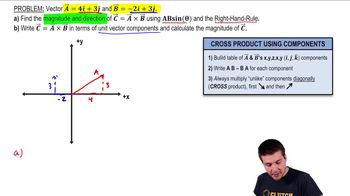
The formula A × B = AB sinθ requires the magnitudes and the angle between the vectors, which are not provided in unit vector notation. Instead, you must use the component method to calculate the cross product.
What is the first step when calculating the cross product of two vectors given in unit vector form?
The first step is to build a table listing the x, y, and z components of both vectors, repeating the x and y columns for easier calculation. This helps organize the components for the diagonal multiplication process.
When calculating the x-component of the cross product, which vector components do you multiply and subtract?
For the x-component, you multiply the y-component of A by the z-component of B and subtract the product of the y-component of B and the z-component of A. This follows the pattern AyBz − ByAz.
How do you determine which components to use when calculating each component (Cx, Cy, Cz) of the cross product?
For each component, you ignore the like component (x for Cx, y for Cy, z for Cz) and use the other two components in a diagonal multiplication and subtraction pattern. This ensures you always use the 'unlike' components for each calculation.
What is the significance of the diagonal multiplication pattern in the cross product calculation?
The diagonal multiplication pattern reflects the 'cross' nature of the product, where you multiply components diagonally across the table. This method ensures the correct sign and order for each term in the result.
Why is it important to pay attention to negative signs when calculating the cross product components?
Negative signs can change the value and direction of the resulting vector components, so careful attention prevents calculation errors. Misplacing a negative can lead to an incorrect final vector.
How is the resulting cross product vector expressed after calculating its components?
The resulting vector is written in unit vector notation as Cx i + Cy j + Cz k. Each component is multiplied by its corresponding unit vector.
What pattern can help you remember the order of multiplication and subtraction for each cross product component?
The pattern AB − BA for each component helps you remember to multiply the appropriate components in order and subtract in the correct sequence. This pattern is consistent for all three components.
What should you do if your professor prefers a different method for calculating the cross product using components?
You should follow your professor's preferred method if they have a strong preference, even if other methods exist. Adhering to their instructions ensures you meet course expectations.