Back

The Carnot Cycle quiz

Control buttons has been changed to "navigation" mode.
1/15
  • What is the Carnot cycle?

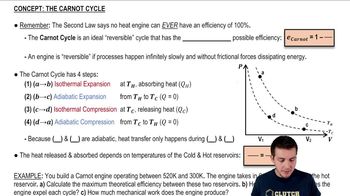
    The Carnot cycle is an ideal reversible cycle that achieves the maximum possible efficiency for a heat engine.
  • How many stages are in the Carnot cycle and what are they?

    There are four stages: two isothermal (heat transfer occurs) and two adiabatic (no heat transfer) processes.
  • What does it mean for a process to be reversible in the context of the Carnot cycle?

    A reversible process occurs infinitely slowly with no friction or energy loss, allowing the system to return to its original state without net energy change.
  • During which steps of the Carnot cycle does heat transfer occur?

    Heat transfer occurs during the two isothermal steps: isothermal expansion (heat absorbed) and isothermal compression (heat released).
  • What is the equation for the maximum theoretical efficiency of a Carnot engine?

    The maximum theoretical efficiency is given by 1 - (Tc/Th), where Tc and Th are the absolute temperatures of the cold and hot reservoirs, respectively.
  • Why can no heat engine ever have 100% efficiency according to the Carnot cycle?

    Because the second law of thermodynamics prohibits 100% efficiency; some energy must always be expelled as waste heat.
  • How is the ratio of waste heat expelled to heat absorbed related to the reservoir temperatures in a Carnot engine?

    The ratio Qc/Qh equals Tc/Th, where Qc is waste heat, Qh is absorbed heat, and Tc and Th are the cold and hot reservoir temperatures.
  • If a Carnot engine operates between 520K and 300K, what is its maximum theoretical efficiency?

    Its maximum theoretical efficiency is 1 - (300/520) = 0.42, or 42%.
  • How do you calculate the amount of waste heat (Qc) expelled each cycle in a Carnot engine?

    Qc is calculated as Qh × (Tc/Th), where Qh is the heat absorbed from the hot reservoir.
  • What is the formula for the mechanical work produced by a Carnot engine per cycle?

    The work produced per cycle is W = Qh - Qc, the difference between heat absorbed and waste heat expelled.
  • What is the significance of the area enclosed by the Carnot cycle on a PV diagram?

    The area represents the net work done by the engine during one complete cycle.
  • What happens during the isothermal expansion step of the Carnot cycle?

    During isothermal expansion, the engine absorbs heat from the hot reservoir while maintaining constant temperature.
  • What characterizes the adiabatic steps in the Carnot cycle?

    During adiabatic steps, there is no heat transfer; the system's temperature changes due to work done.
  • Why does the Carnot efficiency depend only on the temperatures of the reservoirs?

    Because the efficiency formula 1 - (Tc/Th) is derived from the properties of reversible processes, which depend solely on reservoir temperatures.
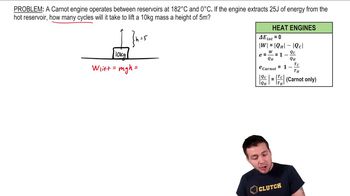
  • If a Carnot engine absorbs 6.45 kJ of heat from the hot reservoir and expels 3.72 kJ as waste heat, how much work does it perform?

    It performs 6.45 kJ - 3.72 kJ = 2.73 kJ of work per cycle.