Back

Collisions with Springs quiz

Control buttons has been changed to "navigation" mode.
1/15
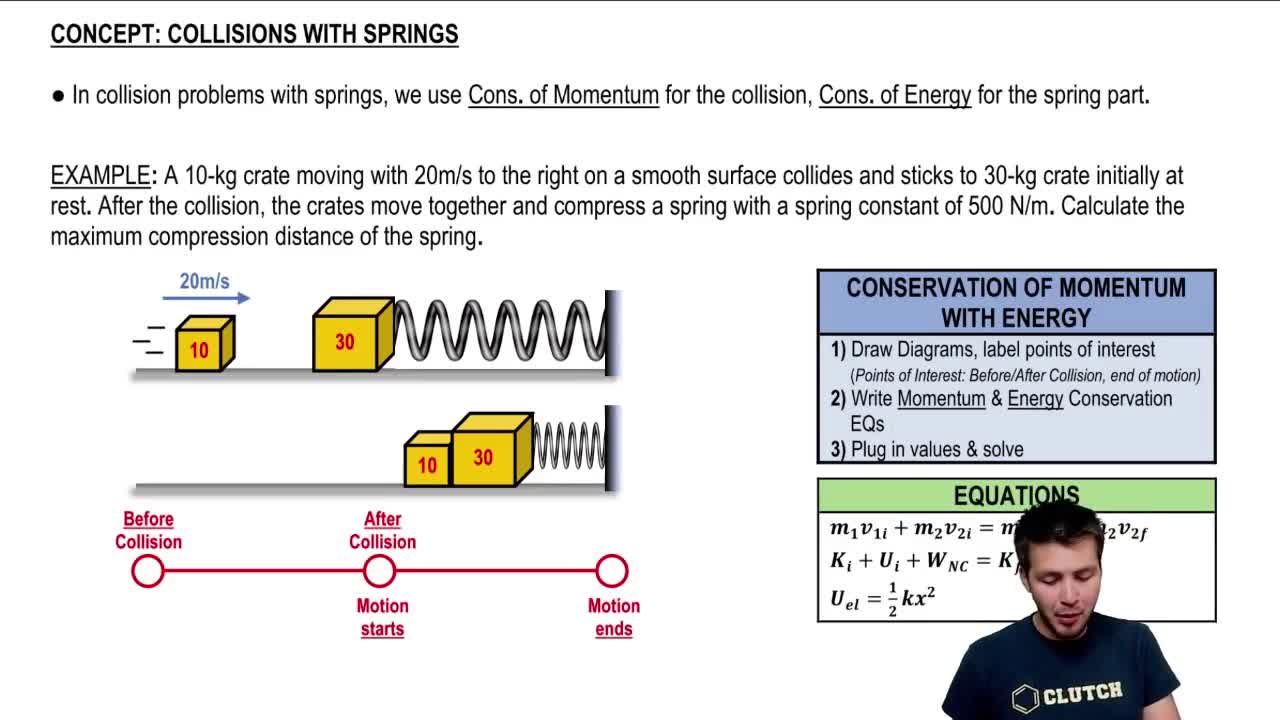
  • What two conservation laws are used to solve a collision followed by spring compression problem?

    Conservation of momentum is used for the collision, and conservation of energy is used for the spring compression.
  • At what point is the spring considered to be relaxed in the problem setup?

    The spring is relaxed before the crates collide and start compressing it.
  • What type of collision occurs between the two crates in the example?

    The collision is completely inelastic, meaning the crates stick together after colliding.
  • How do you find the velocity of the crates immediately after the collision (Vb)?

    You use conservation of momentum, setting the total initial momentum equal to the total final momentum of the combined mass.
  • What is the formula for the maximum compression distance (Xc) of the spring derived in the lesson?

    Xc = sqrt((M/K) * Vb^2), where M is the combined mass, K is the spring constant, and Vb is the velocity after collision.
  • What is the value of the velocity (Vb) of the crates after the collision in the example?

    The velocity Vb is calculated to be 5 m/s.
  • What is the combined mass (M) of the crates after the collision in the example?

    The combined mass M is 40 kg (10 kg + 30 kg).
  • What is the spring constant (K) used in the example problem?

    The spring constant K is 500 N/m.
  • What is the maximum compression distance (Xc) of the spring calculated in the example?

    The maximum compression distance Xc is approximately 1.41 meters.
  • At the point of maximum compression, what is the velocity of the crates?

    The velocity of the crates is zero at maximum compression.
  • What happens to the kinetic energy of the crates at maximum spring compression?

    The kinetic energy is zero because the crates have stopped moving.
  • What form of energy is maximized at either end of the spring compression process?

    Elastic potential energy is maximized at maximum compression.
  • Why is there no gravitational potential energy considered in the energy equation for this problem?

    Because the motion is horizontal and there is no change in height, gravitational potential energy does not change.
  • Why is there no work done by non-conservative forces in this problem?

    There is no friction or external force acting, so non-conservative work is zero.
  • What is the expression for elastic potential energy stored in a compressed spring?

    Elastic potential energy is given by (1/2)Kx^2, where K is the spring constant and x is the compression distance.