Combining Resistors in Series & Parallel quiz #1 Flashcards

Combining Resistors in Series & Parallel quiz #1
Control buttons has been changed to "navigation" mode.
1/10
  • When two resistors are connected in series, what physical quantity must be the same for both resistors?
    When resistors are connected in series, the current passing through each resistor must be the same.
  • How do you find the equivalent resistance of a network of resistors connected in series and parallel?
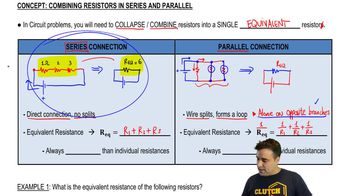
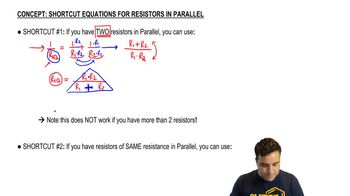
    To find the equivalent resistance, add the resistances directly for series connections (Req = R1 + R2 + ...), and for parallel connections use 1/Req = 1/R1 + 1/R2 + ... For two resistors in parallel, you can use Req = (R1 × R2) / (R1 + R2).
  • Between a series circuit and a parallel circuit with the same resistors, which configuration has the smallest equivalent resistance?
    A parallel circuit has the smallest equivalent resistance compared to a series circuit with the same resistors.
  • What visual feature in a circuit diagram indicates that resistors are connected in parallel?
    A parallel connection is indicated by resistors being alone on opposite branches or sides of a split in the wire. This creates separate loops for current to travel through.
  • How does the equivalent resistance of a group of resistors in series compare to the largest individual resistance in the group?
    The equivalent resistance in series is always greater than the largest individual resistance. This is because all resistances are added together.
  • What happens to the current at a junction where a wire splits in a parallel resistor network?
    At a junction in a parallel network, the current splits so that some charge flows through each branch. This division allows electrons to take multiple paths, reducing overall resistance.
  • Why is it incorrect to use the two-resistor parallel shortcut formula for three or more resistors?
    The shortcut formula R1*R2/(R1+R2) only works for two resistors because the math does not generalize to more branches. Using it for three or more resistors gives the wrong equivalent resistance.
  • What is the equivalent resistance of three identical resistors, each of resistance R, connected in parallel?
    The equivalent resistance is R divided by 3. This shortcut applies whenever all parallel resistors have the same value.
  • In simplifying a complex resistor network, what is a recommended first step before performing calculations?
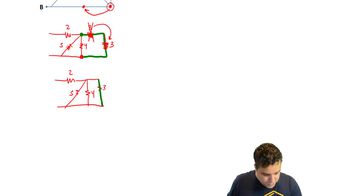
    A good first step is to map out which resistors can be combined in series or parallel and redraw the circuit accordingly. This helps clarify the sequence of combinations needed.
  • How does the battery 'see' a group of resistors that have been replaced by their equivalent resistance?
    The battery cannot distinguish between the original group of resistors and their equivalent single resistor. It experiences the same total resistance in both cases.