Back

Conceptual Problems with Velocity-Time Graphs quiz

Control buttons has been changed to "navigation" mode.
1/15
  • On a velocity-time graph, what does a positive value indicate about the direction of motion?

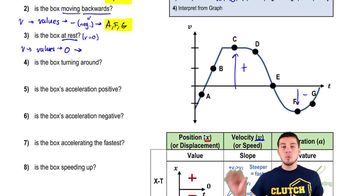
    A positive value indicates the object is moving forwards.
  • How do you determine when an object is moving backwards on a velocity-time graph?

    The object is moving backwards when the velocity values are negative, i.e., below the time axis.
  • What does it mean when the velocity value is zero on a velocity-time graph?

    A velocity of zero means the object is at rest.
  • How can you identify when an object is turning around using a velocity-time graph?

    The object is turning around when the velocity changes sign, which occurs where the graph crosses the time axis.
  • What graph feature do you examine to determine acceleration on a velocity-time graph?

    You examine the slope of the velocity-time graph to determine acceleration.
  • What does an upward slope on a velocity-time graph represent?

    An upward slope represents positive acceleration.
  • What does a downward slope on a velocity-time graph indicate?

    A downward slope indicates negative acceleration.
  • How do you find where the object is accelerating the fastest on a velocity-time graph?

    The object is accelerating the fastest where the slope is steepest or most vertical.
  • What does it mean if the velocity-time graph is flat (horizontal) at a certain interval?

    A flat (horizontal) graph means the acceleration is zero during that interval.
  • How do you determine where the object is speeding up on a velocity-time graph?

    The object is speeding up wherever the graph moves away from the time axis, increasing the magnitude of velocity.
  • What does it mean if the velocity-time graph is moving towards the time axis?

    Moving towards the time axis means the object is slowing down.
  • When analyzing a velocity-time graph, which feature do you use to find velocity values?

    You use the values on the y-axis of the graph to find velocity.
  • What is the significance of the graph crossing the time axis on a velocity-time graph?

    Crossing the time axis signifies a change in direction, or turning around.
  • How do you distinguish between positive and negative acceleration on a velocity-time graph?

    Positive acceleration is shown by an upward slope, while negative acceleration is shown by a downward slope.
  • What is the relationship between the steepness of the slope and the magnitude of acceleration on a velocity-time graph?

    The steeper the slope, the greater the magnitude of acceleration.