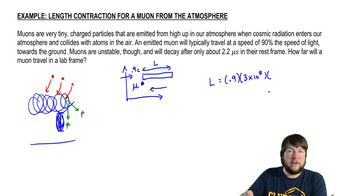
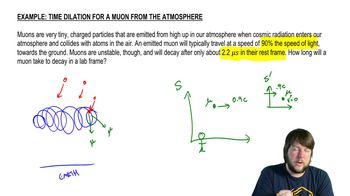
Time dilation is the phenomenon where time appears to stretch in a moving frame compared to a stationary frame, due to the constant speed of light.
How is the proper time defined in the context of special relativity?
Proper time is the time measured in the frame at rest with respect to the event or object being observed.
What is the Lorentz factor (gamma) and how is it calculated?
The Lorentz factor, gamma, is calculated as 1 divided by the square root of 1 minus u squared over c squared, where u is the relative speed and c is the speed of light.
How does the speed of light affect measurements in different frames?
The speed of light remains constant in all inertial frames, which leads to differences in measured time and length between moving and stationary observers.
What is length contraction in special relativity?
Length contraction is the effect where objects in motion appear shorter in the direction of motion compared to their length at rest.
How do you calculate contracted length in a moving frame?
Contracted length is calculated by dividing the proper length by the Lorentz factor (gamma).
In the train thought experiment, which frame measures the proper time?
The proper time is measured in the frame moving with the train, where the event (light traveling up and down) occurs at rest.
What happens to the dilated time as the speed u increases?
As u increases, gamma increases, so the dilated time becomes larger compared to the proper time.
Why is the contracted length always less than the proper length?
Because gamma is always greater than 1, dividing the proper length by gamma results in a contracted length that is always shorter.
What is the difference between proper and non-proper frames?
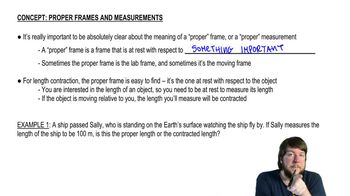
The proper frame is at rest with respect to the object or event being measured, while the non-proper frame is moving relative to it.
If a spaceship is measured to be 100 meters long while being built on Earth, is this the proper or contracted length?
This is the proper length, since the spaceship is at rest relative to the observers measuring it.
How does time dilation affect astronauts traveling at Earth's escape velocity?
At Earth's escape velocity (11.2 km/s), time dilation is negligible, so astronauts do not notice any difference in time compared to clocks on Earth.
In the example of an astronaut and his brother, who measures the proper time?
The astronaut measures the proper time, as he is at rest with respect to his own aging during the trip.
What is the contracted length observed by someone on Earth for a spaceship moving at 10% the speed of light?
The contracted length is about 99.5 meters, which is half a percent shorter than the proper length of 100 meters.
How do you determine which frame is proper for a given measurement?
The proper frame is always the one at rest with respect to the object or event you are interested in measuring.
 Back
Back

 07:49
07:49