Back

Conservation of Charge quiz

Control buttons has been changed to "navigation" mode.
1/15
  • What does the law of conservation of charge state?

    It states that charge cannot be created or destroyed; it can only move from one object to another.
  • If one object in a system gains charge, what must happen to another object?

    Another object must lose an equivalent amount of charge to conserve the total charge in the system.
  • Name three processes by which charge can be transferred between objects.

    Charge can be transferred by induction, conduction, or polarization.
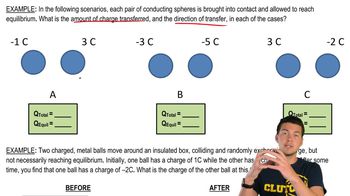
  • What happens when two conducting spheres are brought into contact?

    Charges move between them until they reach equilibrium, meaning both spheres have equal charge.
  • How do you find the equilibrium charge when two spheres with charges +3 C and -1 C are brought together?

    Add the charges to get 2 C, then divide by 2; each sphere will have +1 C at equilibrium.
  • If two spheres have charges of -5 C and -3 C, what is the equilibrium charge after contact?

    The total charge is -8 C, so each sphere will have -4 C at equilibrium.
  • How much charge is transferred when a sphere with -3 C becomes -4 C after contact with a -5 C sphere?

    1 C is transferred from the -3 C sphere to the -5 C sphere.
  • Can you have half of a Coulomb of charge on an object?

    Yes, because a Coulomb is a large unit, but you cannot have half of an electron.
  • What is the final charge on each sphere if they start with +3 C and -2 C?

    Each sphere will have +0.5 C after reaching equilibrium.
  • How much charge is transferred when a +3 C sphere and a -2 C sphere reach equilibrium?

    2.5 C is transferred from the +3 C sphere to the -2 C sphere.
  • In an insulated box, if two metal balls start with charges of +1 C and +3 C, what is the total charge?

    The total charge is +4 C.
  • If after a collision in an insulated box, one ball has -2 C, what must the other ball's charge be to conserve charge?

    The other ball must have +6 C so the total remains +4 C.
  • Why can't the walls of an insulated box pick up charge in these scenarios?

    Because the box is insulated, preventing charge transfer to or from the walls.
  • What equation represents conservation of charge before and after an event in a closed system?

    The total charge before equals the total charge after: Q_total_before = Q_total_after.
  • Why is it important not to focus on the movement of electrons when calculating charge transfer between spheres?

    Because only the net movement of charge matters for conservation, not the specific particles involved.