Energy in Connected Objects (Systems) quiz #1 Flashcards

Energy in Connected Objects (Systems) quiz #1
Control buttons has been changed to "navigation" mode.
1/10
  • Which statement accurately describes the energy of a pendulum during its motion?
    The energy of a pendulum is conserved (ignoring friction and air resistance), with its total mechanical energy being the sum of kinetic and potential energy. At its highest points, the pendulum has maximum potential energy and zero kinetic energy; at the lowest point (equilibrium), it has maximum kinetic energy and minimum potential energy.
  • At the equilibrium position of a pendulum, where the potential energy is zero, what is the velocity of the pendulum?
    At the equilibrium position, where the potential energy is zero, the velocity of the pendulum is at its maximum value.
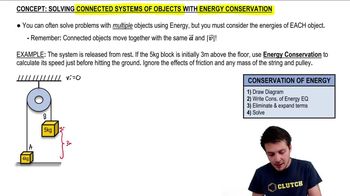
  • Why do both blocks in the Atwood machine have the same final speed just before block B hits the floor?
    Both blocks are connected by a string over a pulley, so they must move together with the same speed. This constraint ensures their final speeds are equal in magnitude.
  • What is the initial kinetic energy of the system if both blocks start from rest?
    The initial kinetic energy is zero because both blocks have an initial velocity of zero. Therefore, neither block is moving at the start.
  • How is the initial gravitational potential energy determined for each block in the Atwood machine example?
    Block A starts on the floor, so its initial gravitational potential energy is zero, while block B starts at a height of 3 meters, giving it nonzero initial potential energy. The potential energy is calculated as mgy for each block.
  • Why is the work done by non-conservative forces zero in this problem?
    There are no applied forces or friction acting on the system after release, as friction and air resistance are ignored. Thus, no energy is added or removed by non-conservative forces.
  • What happens to the gravitational potential energy of block A as block B descends?
    As block B descends, block A rises to the same height that block B started from. This means block A gains gravitational potential energy equal to m_a * g * y_final.
  • Why can't you cancel out the masses of the blocks when setting up the energy conservation equation?
    The masses of the two blocks are different and appear in separate terms in the equation. You can only cancel masses if they are common factors in all terms, which is not the case here.
  • What is the target variable when solving for the final speed using energy conservation in this system?
    The target variable is the final speed (v_final) of the blocks. This is the unknown you solve for after substituting all known values into the energy equation.
  • How does the energy conservation approach simplify solving multi-object problems compared to using forces?
    Energy conservation allows you to use a single equation for the whole system, rather than writing separate force equations for each object. This reduces the complexity of the problem-solving process.