Energy of Circular Orbits definitions Flashcards
Energy of Circular Orbits definitions
You can tap to flip the card.
Control buttons has been changed to "navigation" mode.
1/15
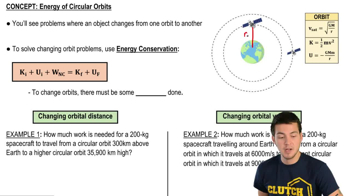
Orbital DistanceThe radius of a satellite's path around a central body, affecting its velocity and energy.Kinetic EnergyEnergy possessed by a satellite due to its motion, calculated as 1/2 mv^2.Potential EnergyEnergy stored due to a satellite's position in a gravitational field, given by -Gmm/r.Energy ConservationPrinciple stating total energy remains constant in an isolated system, used to solve orbit problems.Gravitational ConstantA universal constant (G) used in calculating gravitational forces and energy.Central BodyThe massive object around which a satellite orbits, such as Earth.WorkEnergy transfer required to change a satellite's orbit, positive for increasing and negative for decreasing.VelocityThe speed and direction of a satellite in orbit, influencing its kinetic energy.VSAT EquationFormula relating orbital velocity to gravitational constant and orbital radius.Initial OrbitThe starting path of a satellite before any work is done to change its orbit.Final OrbitThe new path of a satellite after work is done to change its orbit.Negative WorkEnergy release required to decrease a satellite's orbit, increasing its velocity.Positive WorkEnergy input required to increase a satellite's orbit, decreasing its velocity.Circular OrbitAn orbit with a constant radius and velocity, simplifying energy calculations.Total EnergySum of kinetic and potential energy in an orbit, expressed as -Gmm/2r or -1/2 mv^2.