What is the standard unit of measurement for kinetic energy in physics?
The standard unit of measurement for kinetic energy is the joule (J).
Which equation expresses the mass-energy equivalence principle in physics?
The mass-energy equivalence is expressed by the equation E = mc^2, where E is energy, m is mass, and c is the speed of light.
What new source of energy enabled machines to operate at any time and place, revolutionizing technology?
The development and use of steam power enabled machines to operate anytime and anyplace, revolutionizing technology.
When an automobile is braked to a stop, into what form is its kinetic energy transformed?
When an automobile is braked to a stop, its kinetic energy is transformed into thermal energy (heat) due to friction.
In what unit are both energy and work measured in physics?
Both energy and work are measured in joules (J) in physics.
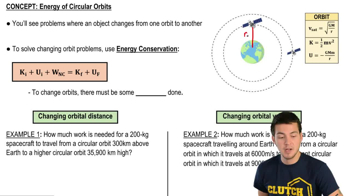
What equation relates the velocity of a satellite in a circular orbit to the radius of its orbit?
The velocity of a satellite in a circular orbit is given by v = sqrt(GM/r), where G is the gravitational constant, M is the mass of the central body, and r is the orbital radius. This relationship allows substitution between velocity and radius in energy equations.
How do you eliminate unknown velocities when calculating the work needed to change a satellite's orbital radius?
You substitute the velocities in the energy equation with the expression sqrt(GM/r) to express everything in terms of known radii. This allows you to solve for work using only the initial and final orbital distances.
What happens to a satellite's velocity when its orbital radius is increased by doing positive work?
When positive work is done to increase a satellite's orbital radius, its velocity decreases. This is because the satellite moves to a higher orbit where less speed is required to maintain circular motion.
What is the total mechanical energy of a satellite in a circular orbit expressed in terms of orbital radius?
The total mechanical energy is E = -GMm/(2r), where G is the gravitational constant, M is the mass of the central body, m is the satellite's mass, and r is the orbital radius. This combines both kinetic and potential energy for the orbit.
How do you express the unknown orbital radius in terms of known velocity when solving energy problems involving changing velocities?
You solve for the radius using r = GM/v^2, where v is the known velocity. This substitution allows you to rewrite the energy equation in terms of velocities instead of radii.