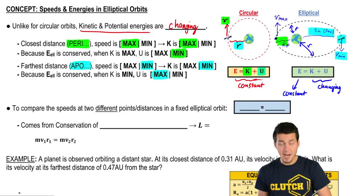
In an elliptical orbit, at what point is the kinetic energy of the orbiting mass at its maximum, and why?
The kinetic energy of the mass in an elliptical orbit is maximum at the closest approach to the focus, known as the periapsis (or perigee). This is because the velocity of the mass is greatest at this point due to gravitational acceleration, resulting in the highest kinetic energy.
How do kinetic and potential energies behave as a mass moves from periapsis to apoapsis in an elliptical orbit?
Kinetic energy decreases and potential energy increases as the mass moves from periapsis to apoapsis. This is due to the mass slowing down as it moves farther from the focus, while total energy remains constant.
What is the relationship between velocity and distance at two points in an elliptical orbit according to conservation of angular momentum?
The product of velocity and distance at one point equals the product at another, expressed as v1*r1 = v2*r2. This relationship allows you to solve for an unknown velocity or distance if the other three variables are known.
Why is it acceptable to use non-SI units for velocity and distance in the v1*r1 = v2*r2 equation?
It is acceptable as long as the units for velocity and distance are consistent throughout the calculation. The units will cancel appropriately, giving a correct answer in the same units used for input.
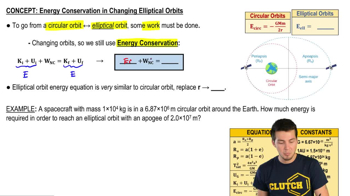
What variable replaces the orbital radius in the total energy equation for elliptical orbits?
The semi-major axis 'a' replaces the orbital radius 'r' in the total energy equation for elliptical orbits. The equation becomes E = -GMm/(2a).
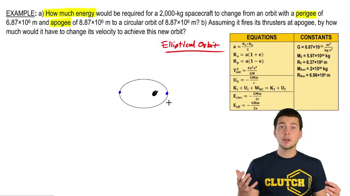
How do you calculate the semi-major axis if given the periapsis and apoapsis distances?
The semi-major axis is calculated as the average of the periapsis and apoapsis distances: a = (rp + ra)/2. This value is essential for energy calculations in elliptical orbits.
When transitioning from a circular to an elliptical orbit, under what condition does the original radius become the periapsis of the new orbit?
If the new elliptical orbit is larger than the original circular orbit, the original radius becomes the periapsis distance. This helps determine the correct values for energy and work calculations.
What does a positive value for work indicate when changing from a circular to a larger elliptical orbit?
A positive value for work indicates that energy must be added to move the object to a higher, larger orbit. This is consistent with the need to increase the object's total mechanical energy.
How does the process of changing from an elliptical to a circular orbit differ from the reverse?
When changing from elliptical to circular, the rules for assigning periapsis and apoapsis to the new radius are reversed compared to the circular-to-elliptical case. The new circular orbit's radius becomes either the apoapsis or periapsis depending on whether the orbit is expanding or contracting.
Why is it important not to confuse the semi-major axis with the apoapsis distance in elliptical orbits?
The semi-major axis is the average of the periapsis and apoapsis distances, not simply the farthest point. Using the wrong value can lead to incorrect energy calculations.