Back

Energy Stored by Capacitor quiz

Control buttons has been changed to "navigation" mode.
1/15
  • What is the equation for the energy stored in a capacitor in terms of capacitance and voltage?

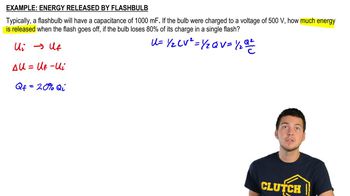
    The energy stored is given by U = 1/2 C V^2, where U is energy, C is capacitance, and V is voltage.
  • How can the energy stored in a capacitor be expressed using charge and voltage?

    It can be written as U = 1/2 Q V, where Q is the charge on the capacitor.
  • What is the formula for energy stored in a capacitor in terms of charge and capacitance?

    The formula is U = 1/2 Q^2 / C.
  • What does the energy density (u) of a capacitor represent?

    Energy density is the energy stored per unit volume, calculated as u = U / volume.
  • How do you calculate the volume between the plates of a parallel plate capacitor?

    The volume is the area of the plates (A) times the separation distance (d), so volume = A * d.
  • What is the formula for the capacitance of a parallel plate capacitor?

    Capacitance is given by C = ε₀ A / d, where ε₀ is the permittivity of free space.
  • How is the energy density of a parallel plate capacitor related to the electric field?

    It is given by u = 1/2 ε₀ E^2, where E is the electric field between the plates.
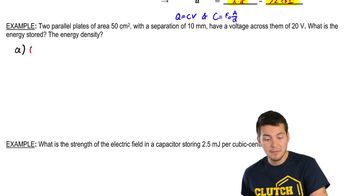
  • If you know the area, separation, and voltage of a parallel plate capacitor, which energy formula should you use?

    Use U = 1/2 C V^2, calculating C with C = ε₀ A / d.
  • Why is it important to convert units when calculating energy or energy density in capacitors?

    Because SI units must be used for consistency, such as converting cm² to m² and mm to m.
  • How do you convert 50 cm² to m²?

    Multiply by 10^-4, so 50 cm² = 0.005 m².
  • What are the units of energy density for a capacitor?

    The units are joules per meter cubed (J/m³).
  • How do you find the electric field strength from energy density in a parallel plate capacitor?

    Use E = sqrt(2u / ε₀), where u is energy density and ε₀ is the permittivity of free space.
  • When converting from cubic centimeters to cubic meters, what is the conversion factor?

    1 cm³ = 1 x 10^-6 m³.
  • If energy density is given in millijoules per cubic centimeter, how do you convert it to joules per cubic meter?

    Multiply the value by 10^-3 (for milli) and divide by 10^-6 (for cm³ to m³), resulting in multiplying by 10^3.
  • What is the significance of the equation u = 1/2 ε₀ E^2 for parallel plate capacitors?

    It shows that the energy density depends only on the electric field between the plates, not on the plate area or separation directly.