Control buttons has been changed to "navigation" mode.
1/10
Terms in this set (10)
What is an equipotential surface in the context of electric potential and electric fields?
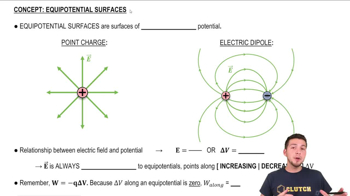
An equipotential surface is a boundary where the electric potential is constant (ΔV = 0) at every point. Electric field lines are always perpendicular to equipotential surfaces, and no work is required to move a charge along an equipotential surface.
Under what condition will a surface be considered an equipotential surface?
A surface will be an equipotential surface if the electric potential is the same at every point on the surface, meaning the potential difference (ΔV) between any two points on the surface is zero.
How are equipotential surfaces for a point charge visually represented?
Equipotential surfaces for a point charge are represented as concentric circles centered on the charge. Each circle corresponds to a specific constant potential value.
What happens to the electric potential as you move farther from a positive point charge?
The electric potential decreases as you move farther from a positive point charge. This is reflected in the equipotential surfaces having lower potential values at greater distances.
How do electric field lines relate to equipotential surfaces in terms of direction?
Electric field lines are always perpendicular to equipotential surfaces. They point in the direction of decreasing electric potential.
What is the shape of the equipotential surface at the midpoint of an electric dipole?
At the midpoint of an electric dipole, the equipotential surface is a straight vertical line. This line is perpendicular to the horizontal electric field at that location.
How does the shape of equipotential surfaces change near the charges of a dipole?
Near the charges of a dipole, equipotential surfaces become warped and curve around the charges. They are no longer straight lines but adapt to remain perpendicular to the local electric field.
What equation relates the electric field to the change in electric potential and distance?
The electric field is related to the change in electric potential and distance by E = -ΔV/Δx. This means the field points in the direction where potential decreases most rapidly.
If you move a charge from one equipotential surface to another, what must be true about the work done?
Moving a charge from one equipotential surface to another requires nonzero work. This is because there is a potential difference between the two surfaces.
How can you calculate the distance from a point charge to a specific equipotential surface?
You can calculate the distance using the formula r = kQ/V, where k is Coulomb's constant, Q is the charge, and V is the potential. This gives the radius at which the potential equals the specified value.