Back

The Otto Cycle quiz

Control buttons has been changed to "navigation" mode.
1/15
  • What is the Otto cycle a theoretical model for?

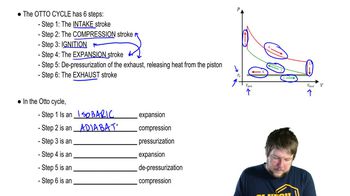
    The Otto cycle is a theoretical model for the gas behavior in a four-stroke internal combustion engine, commonly found in gasoline cars.
  • How many steps are there in the Otto cycle?

    There are six steps in the Otto cycle.
  • What type of process is the intake stroke in the Otto cycle?

    The intake stroke is an isobaric expansion, meaning it occurs at constant pressure.
  • What happens during the compression stroke in the Otto cycle?

    During the compression stroke, the piston compresses the fuel-air mixture rapidly, making it dense and high-pressure; this is an adiabatic process.
  • What is the ignition stroke characterized by in the Otto cycle?

    The ignition stroke is an isochoric pressurization, occurring at constant volume with a rapid increase in pressure.
  • What type of process is the expansion stroke in the Otto cycle?

    The expansion stroke is an adiabatic process, where the piston is pushed away rapidly by the expanding gas.
  • What happens during the second half of the expansion stroke in the Otto cycle?

    The second half of the expansion stroke is an isochoric depressurization, where heat leaves the cylinder and pressure drops at constant volume.
  • What is the exhaust stroke in the Otto cycle?

    The exhaust stroke is an isobaric process, where exhaust gases are expelled at constant pressure.
  • Why is the Otto cycle considered an idealized model?

    The Otto cycle is idealized because real engines do not perfectly follow its steps, but it closely approximates the actual process.
  • How is the work done by the gas in the Otto cycle calculated?

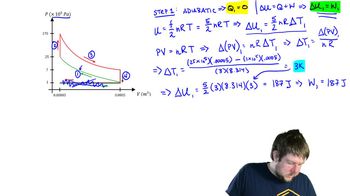
    The work is calculated by finding the area enclosed by the cycle on a PV diagram, focusing on the isobaric processes.
  • Which steps in the Otto cycle do not contribute to work, and why?

    Isochoric steps do not contribute to work because they occur at constant volume, and no work is done during constant volume processes.
  • How are the areas for work calculation in the Otto cycle approximated?

    The areas are approximated by breaking the cycle into geometric shapes, such as triangles and rectangles, on the PV diagram.
  • What does a negative value for work indicate in the Otto cycle?

    A negative value for work indicates that work is done by the gas, which is typical for an engine releasing energy.
  • Why is the sign of the work important in the Otto cycle calculation?

    The sign determines whether work is done by or on the gas; negative means by the gas, positive means on the gas.
  • What is the main purpose of the Otto cycle in an engine?

    The Otto cycle allows the gas to undergo a cycle that releases energy, enabling the engine to do work and power a vehicle.