Back

Gravitational Potential Energy quiz

Control buttons has been changed to "navigation" mode.
1/15
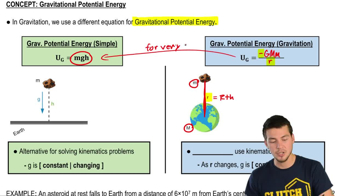
  • What is the equation for gravitational potential energy between two masses?

    The equation is U = -GmM/r, where G is the gravitational constant, m and M are the masses, and r is the distance between their centers.
  • Why is there a negative sign in the gravitational potential energy equation?

    The negative sign indicates that gravitational potential energy is zero at infinite separation and becomes more negative as the masses get closer.
  • What does the variable 'r' represent in the gravitational potential energy equation?

    'r' is the distance from the center of one mass to the center of the other mass.
  • When can you use the simplified potential energy equation U = mgh?

    You can use U = mgh when the change in height (delta h) is very small compared to the radius of the planet.
  • Why can't you use kinematics equations for gravitational problems involving large distances?

    Because the gravitational acceleration g changes with distance, so it is not constant over large distances.
  • What principle allows you to solve gravitational potential energy problems when g is not constant?

    The conservation of energy principle allows you to solve these problems using the gravitational potential energy equation.
  • In the asteroid example, why is the Earth's velocity ignored in the kinetic energy calculation?

    The Earth's velocity is ignored because its mass is so large that its movement is negligible compared to the asteroid.
  • What happens to the gravitational potential energy at the surface of the Earth?

    At the surface, the distance r becomes the Earth's radius, so there is still some gravitational potential energy.
  • How do you set up the energy conservation equation for an object falling towards Earth?

    Set the initial potential energy plus initial kinetic energy equal to the final potential energy plus final kinetic energy.
  • Why does the mass of the asteroid cancel out when solving for its final velocity?

    The mass appears in both the potential and kinetic energy terms, so it cancels out algebraically.
  • What is the final formula for the asteroid's impact velocity derived from energy conservation?

    The final velocity is v = sqrt[2GM(1/R - 1/r_initial)], where R is Earth's radius and r_initial is the starting distance from Earth's center.
  • What is the value of the gravitational constant G used in these calculations?

    G is 6.67 x 10^-11 N·m²/kg².
  • What is the mass of the Earth used in the asteroid example?

    The mass of the Earth is 5.97 x 10^24 kg.
  • What is the calculated final velocity of the asteroid as it impacts Earth in the example?

    The final velocity is 1.06 x 10^4 meters per second.
  • Why is it important to use the center-to-center distance in gravitational potential energy calculations?

    Because the gravitational force and potential energy depend on the distance between the centers of mass of the two objects.