Skip to main content
Physics with Calculus
My Course
Learn
Exam Prep
AI Tutor
Study Guides
Textbook Solutions
Flashcards
Explore
Try the app
My Course
Learn
Exam Prep
AI Tutor
Study Guides
Textbook Solutions
Flashcards
Explore
Try the app
Back
Heat Equations for Special Processes & Molar Specific Heats definitions
You can tap to flip the card.
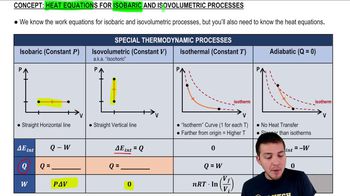
Isobaric Process
You can tap to flip the card.
👆
Isobaric Process
A thermodynamic process occurring at constant pressure, often involving work done by or on the system.
Track progress
Control buttons has been changed to "navigation" mode.
1/15
Related flashcards
Related practice
Recommended videos
Heat Equations for Special Processes & Molar Specific Heats quiz
Heat Equations for Special Processes & Molar Specific Heats
10 Terms
Heat Equations for Special Processes & Molar Specific Heats
22. The First Law of Thermodynamics
9 problems
Topic
Patrick
First Law of Thermodynamics
22. The First Law of Thermodynamics
5 problems
Topic
Patrick
22. The First Law of Thermodynamics
5 topics
13 problems
Chapter
Patrick
Guided course
05:42
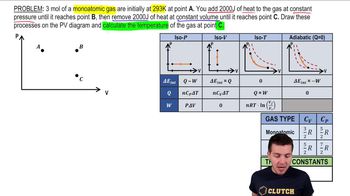
Calculating Temperature Changes
3815
views
44
rank
1
comments
Guided course
06:44
Heat Equations for Isobaric & Isovolumetric Processes
6754
views
52
rank
6
comments
Terms in this set (15)
Hide definitions
Isobaric Process
A thermodynamic process occurring at constant pressure, often involving work done by or on the system.
Isovolumetric Process
A thermodynamic process occurring at constant volume, where no work is done by the system.
Molar Specific Heat
The amount of heat required to raise the temperature of one mole of a substance by one degree Celsius.
C_P
Molar specific heat at constant pressure, used in isobaric processes.
C_V
Molar specific heat at constant volume, used in isovolumetric processes.
Monoatomic Gas
A gas consisting of single atoms, with specific heat values of 3/2 R for C_V and 5/2 R for C_P.
Diatomic Gas
A gas consisting of molecules with two atoms, with specific heat values of 5/2 R for C_V and 7/2 R for C_P.
Internal Energy
The total energy contained within a system, including kinetic and potential energy of particles.
Heat Transfer
The process of energy transfer from one body or system to another due to temperature difference.
PV Diagram
A graphical representation of the pressure-volume relationship in a thermodynamic process.
First Law of Thermodynamics
Energy conservation principle stating that the change in internal energy equals heat added minus work done.
R (Gas Constant)
A constant used in equations of state for gases, approximately 8.314 J/(mol·K).
Isotherm
A line on a PV diagram representing a process occurring at constant temperature.
Delta T
The change in temperature, calculated as the final temperature minus the initial temperature.
Calorimetry
The science of measuring the heat of chemical reactions or physical changes.
 BackBack
 05:42
05:42