Skip to main content
Physics with Calculus
My Course
Learn
Exam Prep
AI Tutor
Study Guides
Textbook Solutions
Flashcards
Explore
Try the app
My Course
Learn
Exam Prep
AI Tutor
Study Guides
Textbook Solutions
Flashcards
Explore
Try the app
Back
How to Solve: Energy vs Torque quiz
You can tap to flip the card.
What are the two primary methods for solving physics problems discussed in the video?
You can tap to flip the card.
👆
What are the two primary methods for solving physics problems discussed in the video?
The two primary methods are Newton's laws (F=ma and motion equations) and conservation of energy.
Track progress
Control buttons has been changed to "navigation" mode.
1/15
Related flashcards
Related practice
Recommended videos
How to Solve: Energy vs Torque definitions
How to Solve: Energy vs Torque
15 Terms
How to Solve: Energy vs Torque
14. Torque & Rotational Dynamics
5 problems
Topic
Torque Due to Weight
14. Torque & Rotational Dynamics
1 problem
Topic
David-Paige
14. Torque & Rotational Dynamics
6 topics
13 problems
Chapter
Patrick
Guided course
10:21
How to Solve:Energy vs Torque
6610
views
63
rank
2
comments
Terms in this set (15)
Hide definitions
What are the two primary methods for solving physics problems discussed in the video?
The two primary methods are Newton's laws (F=ma and motion equations) and conservation of energy.
When solving for final velocity in a linear motion problem, which method is usually simpler?
Conservation of energy is usually simpler because it uses one equation instead of multiple motion equations.
What equation is used to find acceleration in linear motion problems?
The equation used is F=ma, where the sum of all forces equals mass times acceleration.
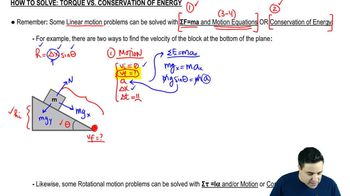
In the example of a block sliding down a frictionless incline, what is the final velocity using energy conservation?
The final velocity is the square root of 2gh, where h is the initial height.
Why is conservation of energy not suitable for finding acceleration?
Conservation of energy does not include acceleration (a) in its equation, so it cannot be used to solve for it.
What method should you use if a problem asks for acceleration or gives acceleration?
You should use Newton's laws (F=ma or torque = I*alpha) if acceleration is asked for or given.
Which method is better for problems asking for velocity or angular velocity?
Conservation of energy is better for problems asking for velocity (v) or angular velocity (omega).
When are motion equations necessary in solving physics problems?
Motion equations are necessary when the problem involves time (delta t) or requires time to be solved.
What is the torque equation used in rotational motion problems?
The torque equation is torque = I*alpha, where I is moment of inertia and alpha is angular acceleration.
How do professors sometimes test your understanding of different methods?
Professors may specify which method to use, such as Newton's laws, even if another method is easier.
Why does a yoyo falling and spinning require both linear and angular equations?
A yoyo has both linear acceleration and angular acceleration, so both F=ma and torque=I*alpha are needed.
If you are asked for the speed after dropping a certain distance, which method should you use?
You should use conservation of energy to find the speed after dropping a certain distance.
What information is needed to use motion equations to solve for time in a falling object problem?
You need to know the acceleration, which can be found using F=ma or energy, and then use motion equations.
What is the main advantage of using conservation of energy over motion equations?
Conservation of energy often simplifies calculations by reducing the number of equations needed.
What should you do if a problem gives you both linear and rotational variables?
You should use both linear (F=ma) and rotational (torque=I*alpha) equations to solve the problem.
 BackBack

 10:21
10:21