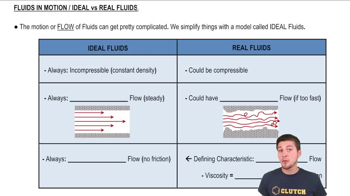
What is the term for a fluid's resistance to flow, and how does it differ between ideal and real fluids?
A fluid's resistance to flow is called viscosity. Real fluids have viscosity, which causes fluid friction and slows down flow, while ideal fluids are considered non-viscous and have no resistance to flow.
How does viscosity affect the flow of real fluids compared to ideal fluids?
Viscosity in real fluids creates fluid friction, making them resist motion and flow more slowly. In contrast, ideal fluids are assumed to have no viscosity, so they flow smoothly without resistance.
What does it mean for an ideal fluid to be incompressible?
An incompressible fluid has a constant density that does not change under pressure. Ideal fluids are always assumed to be incompressible in physics problems.
How does turbulent flow differ from laminar flow in fluids?
Laminar flow is smooth and steady, while turbulent flow is chaotic and involves irregular motion. Turbulence usually occurs in real fluids when the flow is too fast or encounters imperfections.
In the context of fluid flow, what is meant by 'non-viscous'?
Non-viscous means the fluid has no internal friction or resistance to motion. Ideal fluids are always considered non-viscous in physics problems.
Why are ideal fluids commonly used in physics problems instead of real fluids?
Ideal fluids simplify calculations by neglecting viscosity, turbulence, and compressibility. This makes it easier to focus on fundamental principles without complex real-world effects.
Under what circumstances might a real fluid be considered compressible?
A real fluid can be compressible under very high pressures, causing its density to increase. Water, for example, becomes slightly more dense at extremely high pressures.
What is the main characteristic that distinguishes real fluids from ideal fluids in terms of flow?
Real fluids exhibit viscous flow, meaning they have internal friction that resists motion. Ideal fluids, in contrast, have non-viscous flow with no resistance.
When solving physics problems, how can you tell if you should treat a fluid as real or ideal?
You should treat a fluid as real if the problem mentions viscosity or specifies real fluid behavior. Otherwise, you can assume the fluid is ideal by default.
Are students typically required to calculate effects of turbulence or compressibility in introductory fluid problems?
No, students are usually not required to calculate turbulence or compressibility effects. Most introductory problems focus on ideal fluids and may only mention viscosity for real fluids.