Index of Refraction quiz #1 Flashcards

Index of Refraction quiz #1
Control buttons has been changed to "navigation" mode.
1/10
  • What is the minimum possible value for the index of refraction of a material?
    The minimum value for the index of refraction is 1, which occurs when light travels in a vacuum.
  • What is the relationship between the index of refraction and the speed of light in a material?
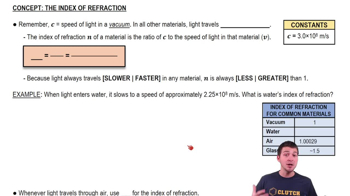
    The index of refraction (n) is defined as the ratio of the speed of light in a vacuum (c) to the speed of light in the material (v): n = c/v.
  • How do you determine the index of refraction of a material if you know the wavelength of red light in that material is 450 nm?
    To determine the index of refraction, you need the speed of light in the material. The wavelength alone is not sufficient unless you also know the frequency or the speed of light in the material. The index of refraction is calculated as n = c/v, where c is the speed of light in a vacuum and v is the speed of light in the material.
  • How does the speed of light in a material change as the index of refraction increases?
    As the index of refraction increases, the speed of light in the material decreases.
  • Why is the index of refraction always greater than or equal to 1?
    The index of refraction is always greater than or equal to 1 because the speed of light in any material is always less than or equal to the speed of light in a vacuum.
  • What does the index of refraction directly measure?
    The index of refraction directly measures how much slower light travels in a material compared to in a vacuum.
  • What is true about the refractive index of a medium?
    The refractive index of a medium is always greater than or equal to 1, and it indicates how much the speed of light is reduced in that medium compared to a vacuum.
  • If the index of refraction of a material is 2, what does this indicate about the speed of light in that material?
    If the index of refraction is 2, it means that light travels at half the speed in the material compared to its speed in a vacuum.
  • Why is it convenient to use the index of refraction values for various materials in problems involving light?
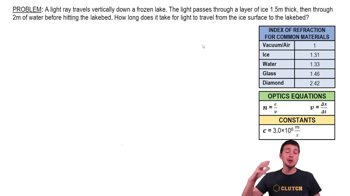
    It is convenient to use the index of refraction values because they allow for easy calculation of how light behaves in different materials without needing to memorize or calculate the speed of light in each material.
  • What shortcut can you use when calculating the index of refraction if the speeds are given in scientific notation with the same base of 10?
    You can ignore the powers of ten and simply divide the numerical coefficients. This makes the calculation faster and easier.