How does increasing the number of loops in a coil affect the strength of the magnetic field produced by the coil?
Increasing the number of loops in a coil increases the strength (magnitude) of the magnetic field produced by the coil.
What is one key difference between electromagnetic waves and mechanical waves?
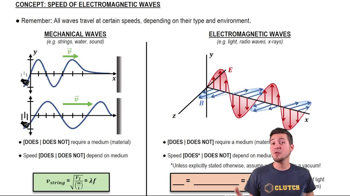
Electromagnetic waves do not require a medium to travel through, while mechanical waves require a material medium such as air, water, or a string.
How are electromagnetic waves different from mechanical waves in terms of their propagation?
Electromagnetic waves consist of oscillating electric and magnetic fields that can propagate through a vacuum, whereas mechanical waves require a physical medium to propagate.
What is the speed of electromagnetic waves propagating in air, and how is it related to the electric and magnetic field magnitudes?
The speed of electromagnetic waves in air (which is very close to a vacuum) is approximately 3.0 x 10^8 meters per second (the speed of light), and it is given by the ratio c = E/B, where E is the magnitude of the electric field and B is the magnitude of the magnetic field.
What is oscillating in an electromagnetic wave as it propagates through space?
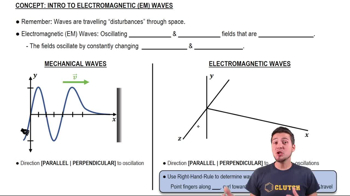
The electric and magnetic fields are oscillating in both magnitude and direction as the wave propagates. These oscillations are what constitute the electromagnetic wave.
How are the electric and magnetic fields oriented relative to each other in an electromagnetic wave?
The electric and magnetic fields are always perpendicular to each other in an electromagnetic wave. This perpendicularity is a fundamental property of electromagnetic waves.
What rule is used to determine the direction of propagation of an electromagnetic wave?
The right-hand rule is used to determine the direction of propagation of an electromagnetic wave. You point your fingers in the direction of the electric field, curl them toward the magnetic field, and your thumb points in the direction of wave travel.
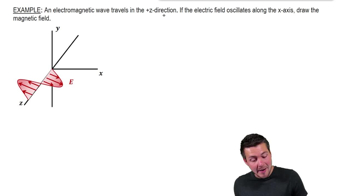
If an electromagnetic wave is traveling in the negative z direction and the electric field points along the positive x axis, in which direction does the magnetic field point?
The magnetic field points in the negative y axis in this scenario. This follows from applying the right-hand rule to the given directions.
What is the formula to calculate the magnitude of the magnetic field in an electromagnetic wave if the electric field and speed of light are known?
The magnitude of the magnetic field is given by B = E/c, where E is the electric field magnitude and c is the speed of light. This formula allows you to solve for B if E and c are known.
Why can electromagnetic waves travel through the vacuum of space while mechanical waves cannot?
Electromagnetic waves do not require a material medium and can propagate through a vacuum. Mechanical waves need a medium, such as air or water, to transmit their energy.
As the wavelength of an electromagnetic wave increases, what happens to its frequency?
As the wavelength increases, the frequency decreases. This is because the speed of electromagnetic waves in a vacuum is constant (c), and wavelength and frequency are inversely related by the equation c = wavelength × frequency.
What is the source of an electromagnetic wave?
The source of an electromagnetic wave is an oscillating electric field and an oscillating magnetic field, which are always perpendicular to each other and propagate through space.
How does a radio wave differ from a sound wave?
A radio wave is an electromagnetic wave, consisting of oscillating electric and magnetic fields and does not require a medium to travel; it can move through a vacuum. A sound wave is a mechanical wave that requires a medium (such as air, water, or a solid) to propagate and consists of oscillations of particles in the medium.
 Back
Back
 05:22
05:22