Skip to main content
Physics with Calculus
My Course
Learn
Exam Prep
AI Tutor
Study Guides
Textbook Solutions
Flashcards
Explore
Try the app
My Course
Learn
Exam Prep
AI Tutor
Study Guides
Textbook Solutions
Flashcards
Explore
Try the app
Back
Work Done Through Multiple Processes quiz
You can tap to flip the card.
How do you calculate the total work done in multiple thermodynamic processes?
You can tap to flip the card.
👆
How do you calculate the total work done in multiple thermodynamic processes?
The total work is the sum of the individual works done in each process.
Track progress
Control buttons has been changed to "navigation" mode.
1/15
Related flashcards
Related practice
Recommended videos
Work Done Through Multiple Processes definitions
Work Done Through Multiple Processes
15 Terms
Work Done Through Multiple Processes
22. The First Law of Thermodynamics
3 problems
Topic
Patrick
Cyclic Thermodynamic Processes
22. The First Law of Thermodynamics
5 problems
Topic
Patrick
22. The First Law of Thermodynamics
5 topics
13 problems
Chapter
Patrick
Guided course
07:44
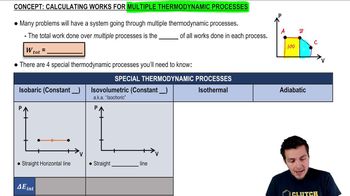
Calculating Works For Multiple Thermodynamic Processes
4203
views
46
rank
Terms in this set (15)
Hide definitions
How do you calculate the total work done in multiple thermodynamic processes?
The total work is the sum of the individual works done in each process.
What is the equation for work done in an isobaric process?
The equation is W = P * ΔV, where P is pressure and ΔV is the change in volume.
What does 'isobaric' mean in thermodynamics?
Isobaric means the process occurs at constant pressure.
What is the work done during an isovolumetric process?
The work done is zero because there is no change in volume (ΔV = 0).
How is an isobaric process represented on a PV diagram?
It is shown as a straight horizontal line, indicating constant pressure.
How is an isovolumetric process represented on a PV diagram?
It is shown as a straight vertical line, indicating constant volume.
If a process goes from point A to B to C, how do you find the total work?
Add the work done from A to B and the work done from B to C.
Why can't you use W = P * ΔV for an isovolumetric process?
Because ΔV is zero, so the work is always zero regardless of pressure changes.
In the example, what is the total work done for the path A to B to C?
The total work is 12,000 joules.
In the example, what is the total work done for the path A to D to C?
The total work is 6,000 joules.
What does it mean when we say work is 'path dependent' in thermodynamics?
It means the amount of work done depends on the specific path taken between two states.
What is the significance of the area under the curve in a PV diagram?
The area under the curve represents the work done during the process.
What is another name for an isovolumetric process?
It is also called an isochoric process.
If a process has constant volume but changing pressure, what is the work done?
The work done is zero because the volume does not change.
How do you determine the sign of work in an isobaric process?
If the volume increases (expansion), work is positive; if volume decreases (compression), work is negative.
 BackBack
 07:44
07:44