Kepler's Third Law for Elliptical Orbits definitions Flashcards
Kepler's Third Law for Elliptical Orbits definitions
You can tap to flip the card.
Control buttons has been changed to "navigation" mode.
1/10
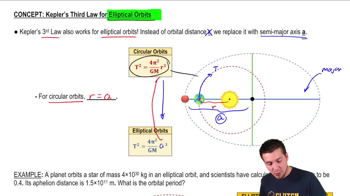
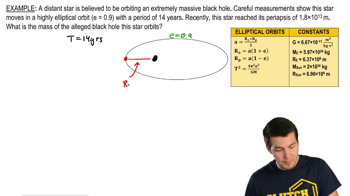
Elliptical OrbitsPaths of celestial objects that are oval-shaped, with varying distances from the central body.Semi-Major AxisHalf the longest diameter of an ellipse, crucial for calculating orbital periods in elliptical orbits.Aphelion DistanceThe farthest point in an orbit from the central body, used to calculate the semi-major axis.EccentricityA measure of how much an orbit deviates from being circular, affecting the shape of the orbit.Orbital PeriodThe time taken for a celestial object to complete one full orbit around another object.Gravitational ConstantA fundamental constant (G) used in the calculation of gravitational forces and orbital dynamics.Mass of Central BodyThe mass of the object being orbited, crucial for determining the orbital period using Kepler's laws.Circular OrbitsA special case of elliptical orbits where the path is a perfect circle, with constant distance from the center.Perihelion DistanceThe closest point in an orbit to the central body, not used in the given example calculation.Kepler's Third LawA law relating the square of the orbital period to the cube of the semi-major axis of an orbit.