Back

LC Circuits quiz

Control buttons has been changed to "navigation" mode.
1/15
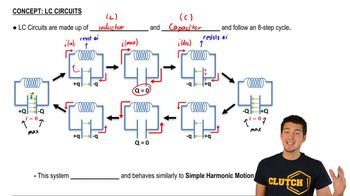
  • What components make up an LC circuit?

    An LC circuit consists of an inductor (L) and a capacitor (C) connected together without a battery or resistor.
  • What happens to the charge and current at the start of the LC circuit cycle?

    At the start, the capacitor has maximum charge and the current is zero.
  • How does the inductor affect changes in current in an LC circuit?

    The inductor resists any rapid changes in current, preventing it from increasing or decreasing instantly.
  • What is the relationship between charge and current when the capacitor is fully discharged?

    When the capacitor is fully discharged, the charge is zero and the current is at its maximum.
  • How does the LC circuit cycle compare to simple harmonic motion?

    The LC circuit oscillates in a manner similar to simple harmonic motion, like a mass-spring system, with energy alternating between two forms.
  • What mathematical functions describe the charge and current in an LC circuit?

    Charge is described by a cosine function and current by a sine function, both involving angular frequency and phase angle.
  • How is the angular frequency (omega) of an LC circuit calculated?

    Angular frequency is calculated as omega = sqrt(1/(LC)), where L is inductance and C is capacitance.
  • What is the formula for maximum current in an LC circuit?

    The maximum current is I_max = omega * Q_max, where omega is the angular frequency and Q_max is the maximum charge.
  • Why must calculators be set to radians mode when solving LC circuit problems?

    Because the charge and current equations use trigonometric functions with angular frequency, which are in radians.
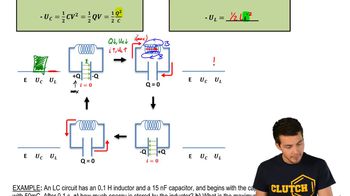
  • Where is electrical energy stored in an LC circuit?

    Electrical energy is stored in the electric field between the plates of the capacitor.
  • Where is magnetic energy stored in an LC circuit?

    Magnetic energy is stored in the magnetic field created by current flowing through the inductor.
  • What is the equation for magnetic energy in an inductor?

    Magnetic energy is given by U_L = (1/2) * L * I^2, where L is inductance and I is current.
  • How does energy conservation manifest in an ideal LC circuit?

    Total energy is conserved and oscillates between electrical energy in the capacitor and magnetic energy in the inductor.
  • What determines the phase angle (phi) in the charge and current equations?

    The phase angle determines the starting point of the oscillation; if the capacitor starts fully charged, phi is zero.
  • How does the energy exchange in an LC circuit compare to kinetic and potential energy in simple harmonic motion?

    As in simple harmonic motion, energy in an LC circuit alternates between electrical (analogous to potential) and magnetic (analogous to kinetic) forms.