Physics
My Course
Learn
Exam Prep
AI Tutor
Study Guides
Textbook Solutions
Flashcards
Explore
My Course
Learn
Exam Prep
AI Tutor
Study Guides
Textbook Solutions
Flashcards
Explore
Back
LR Circuits quiz
You can tap to flip the card.
Define:
What components make up an LR circuit?
You can tap to flip the card.
👆
What components make up an LR circuit?
An LR circuit consists of an inductor (L) and a resistor (R), typically connected to a battery and switches.
Track progress
Control buttons has been changed to "navigation" mode.
1/15
Related flashcards
Related practice
Recommended videos
LR Circuits definitions
LR Circuits
15 Terms
LR Circuits
30. Induction and Inductance
4 problems
Topic

Patrick
LC Circuits
30. Induction and Inductance
3 problems
Topic
Patrick
30. Induction and Inductance - Part 1 of 2
5 topics
8 problems
Chapter
Patrick
30. Induction and Inductance - Part 2 of 2
6 topics
8 problems
Chapter
David-Paige
Guided course
07:50
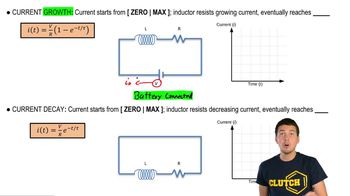
LR Circuits
Patrick
4570
views
55
rank
1
comments
Guided course
03:07
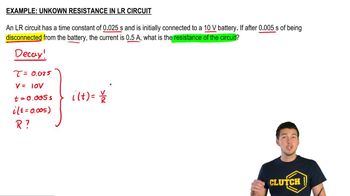
Unknown Resistance in an LR Circuit
Patrick
3191
views
37
rank
1
comments
Terms in this set (15)
Hide definitions
What components make up an LR circuit?
An LR circuit consists of an inductor (L) and a resistor (R), typically connected to a battery and switches.
What happens in an LR circuit when switch S1 is closed and S2 is open?
Current begins to grow in the circuit, driven by the battery, and is opposed by the inductor.
What is the term for the process when current increases in an LR circuit after the battery is connected?
This process is called current growth.
How does the inductor affect current growth in an LR circuit?
The inductor resists rapid changes in current, causing the current to increase gradually rather than instantly.
What mathematical form does the current growth in an LR circuit follow?
Current growth follows an exponential equation similar to that in RC circuits.
After a long time, what value does the current in an LR circuit approach during current growth?
The current approaches a maximum value of V/R, where V is the battery voltage and R is the resistance.
What happens when the battery is disconnected (S1 opened, S2 closed) in an LR circuit?
The current begins to decay, gradually decreasing as it dissipates through the resistor.
What is the term for the process when current decreases in an LR circuit after the battery is disconnected?
This process is called current decay.
How does the inductor affect current decay in an LR circuit?
The inductor resists the decrease in current, causing the current to decay gradually rather than dropping instantly.
What mathematical form does the current decay in an LR circuit follow?
Current decay follows an exponential equation, eventually reducing the current to zero.
What is the time constant (tau) in an LR circuit and how is it calculated?
The time constant tau is given by L/R, where L is the inductance and R is the resistance.
How does a lower time constant (tau) affect current changes in an LR circuit?
A lower tau means that current growth and decay happen more quickly.
How does a higher inductance (L) or lower resistance (R) affect the time constant in an LR circuit?
A higher L or lower R increases the time constant, causing current changes to occur more slowly.
What happens to the exponential term in the current equations for LR circuits after a long time?
The exponential term approaches zero, so the current reaches its final value (V/R for growth, 0 for decay).
How can you distinguish between current growth and current decay in an LR circuit based on the battery's connection?
Current growth occurs when the battery is connected; current decay occurs when the battery is disconnected.