LRC Circuits definitions Flashcards

LRC Circuits definitions
Control buttons has been changed to "navigation" mode.
1/15
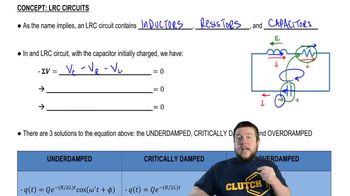
  • Inductor
    A component in LRC circuits that stores energy in a magnetic field and affects current change.
  • Resistor
    A component that opposes the flow of electric current, causing energy dissipation.
  • Capacitor
    A device that stores electrical energy in an electric field, initially charged in LRC circuits.
  • Kirchhoff's Loop Rule
    A principle stating that the sum of voltages around a closed loop equals zero.
  • Voltage
    The electric potential difference across a component in a circuit.
  • Current
    The flow of electric charge, influenced by the discharge of the capacitor in LRC circuits.
  • Differential Equation
    An equation involving derivatives that describes the behavior of LRC circuits.
  • Underdamped
    A circuit condition where resistance is low, causing oscillatory behavior with decreasing amplitude.
  • Critically Damped
    A state where the circuit reaches equilibrium without oscillating, ideal for quick stabilization.
  • Overdamped
    A condition with high resistance, preventing oscillations and resembling an RC circuit.
  • Angular Frequency
    The rate of oscillation in underdamped circuits, affected by resistance and inductance.
  • Energy Dissipation
    The process of energy loss in a circuit, primarily through the resistor.
  • Oscillation
    The repetitive variation in charge or current, seen in underdamped circuits.
  • Equilibrium
    The state where the circuit stabilizes without oscillations, as in critically damped circuits.
  • Charge
    The quantity of electricity held by the capacitor, influencing current and voltage.