Phase Constant quiz #1 Flashcards

Phase Constant quiz #1
Control buttons has been changed to "navigation" mode.
1/10
  • What is the phase constant in a wave function, and how is it determined for a wave that does not start at zero or at its amplitude?
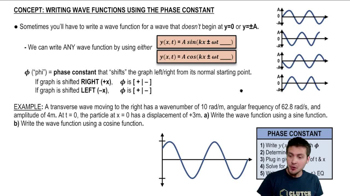
    The phase constant (Φ) in a wave function shifts the wave left or right to match its actual starting position. It is determined by using the initial displacement at x = 0 and t = 0. For a sine function, Φ is found by solving sin(Φ) = y₀/A, where y₀ is the initial displacement and A is the amplitude. For a cosine function, solve cos(Φ) = y₀/A. The sign of Φ depends on whether the wave is shifted left (positive Φ) or right (negative Φ) from the standard starting position.
  • How do you calculate the phase constant Φ for a wave with amplitude A and initial displacement y₀ at x = 0 and t = 0 using a sine function?
    To calculate the phase constant Φ using a sine function, set up the equation y₀ = A * sin(Φ), where y₀ is the initial displacement and A is the amplitude. Solve for Φ: Φ = arcsin(y₀/A).
  • How do you calculate the phase constant Φ for a wave with amplitude A and initial displacement y₀ at x = 0 and t = 0 using a cosine function?
    To calculate the phase constant Φ using a cosine function, set up the equation y₀ = A * cos(Φ), where y₀ is the initial displacement and A is the amplitude. Solve for Φ: Φ = arccos(y₀/A).
  • What is the physical significance of the phase constant Φ₀ in a wave function?
    The phase constant Φ₀ in a wave function represents the initial phase shift of the wave, determining where the wave starts relative to the standard sine or cosine graph. It allows the wave function to match the actual starting displacement at x = 0 and t = 0.
  • What does the phase constant do to the graph of a wave function?
    The phase constant shifts the graph of the wave function left or right from its standard starting position. This allows the function to match the actual initial displacement of the wave.
  • How do you determine the sign of the phase constant when using a sine function for a wave shifted from its normal position?
    If the wave is shifted to the left of the normal sine starting position, the phase constant is positive. If it is shifted to the right, the phase constant is negative.
  • What is the value of the phase constant in radians when the initial displacement is 3 meters and the amplitude is 4 meters using a sine function?
    The phase constant is 0.85 radians. This is found by taking the inverse sine of 3/4.
  • What is the complete wave function using a sine function for a wave with amplitude 4, wave number 10, angular frequency 62.8, and phase constant 0.85?
    The complete wave function is y(x, t) = 4 * sin(10x - 62.8t + 0.85). This incorporates all the given parameters and the calculated phase constant.
  • When expressing the same wave with a cosine function, what is the calculated phase constant and its sign?
    The phase constant is -0.72 radians when using a cosine function. The negative sign indicates a shift to the right from the normal cosine starting position.
  • Why do the phase constants differ when expressing the same wave with sine and cosine functions?
    The phase constants differ because sine and cosine functions have different standard starting points, requiring different shifts to match the same initial displacement. This results in different values and signs for the phase constant depending on the function used.