Back

Phase Diagrams, Triple Points and Critical Points quiz

Control buttons has been changed to "navigation" mode.
1/15
  • What does a phase diagram represent for a substance?

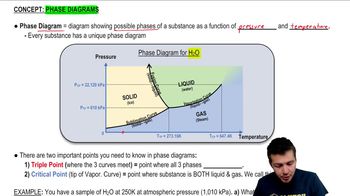
    A phase diagram shows the possible phases of a substance as a function of pressure (y-axis) and temperature (x-axis).
  • How do you determine the phase of a sample using a phase diagram?

    Locate the sample's temperature and pressure on the diagram and find the intersection to see which phase region it falls into.
  • What are the three main regions in the phase diagram of water?

    The three main regions are solid (ice), liquid (water), and gas (steam).
  • What is the fusion curve on a phase diagram?

    The fusion curve is the boundary between the solid and liquid regions, where melting and freezing occur.
  • What phase change occurs along the vaporization curve?

    Along the vaporization curve, liquid turns into gas (boiling) and gas turns into liquid (condensation).
  • What is the sublimation curve?

    The sublimation curve is the boundary where a solid turns directly into a gas without becoming a liquid first.
  • What is the triple point on a phase diagram?

    The triple point is the unique temperature and pressure where all three phases (solid, liquid, gas) coexist in equilibrium.
  • At what temperature does the triple point of water occur?

    For water, the triple point occurs at 273 K.
  • What is the critical point on a phase diagram?

    The critical point is the temperature and pressure at the end of the vaporization curve where the distinction between liquid and gas disappears.
  • What is the state of matter called beyond the critical point?

    Beyond the critical point, the substance is called a fluid, as it is neither a true liquid nor a true gas.
  • What happens if you increase the temperature at constant pressure starting from ice?

    You will cross the fusion curve, causing the ice to melt into liquid water.
  • What happens if you decrease the pressure at constant temperature starting from ice?

    You will cross the sublimation curve, causing the ice to sublimate directly into steam (gas).
  • Why does each substance have a unique phase diagram?

    Each substance has different properties, so their phase boundaries and critical/triple points occur at different temperatures and pressures.
  • What phase is water in at 250 K and 1000 kPa according to the phase diagram?

    At 250 K and 1000 kPa, water is in the solid phase (ice).
  • What does it mean for all three phases to be in equilibrium at the triple point?

    It means solid, liquid, and gas can coexist without any phase changing into another at that specific temperature and pressure.