What role do polarization filters play in three-dimensional projection systems?
Polarization filters in three-dimensional projection systems are used to control the orientation of light waves, allowing each eye to receive light polarized in a different direction. This enables the viewer to perceive separate images for each eye, creating a 3D effect.
What is an example of polarization in the context of light?
An example of polarization is when unpolarized light passes through a polarizing filter, resulting in light that oscillates only in the direction parallel to the filter's transmission axis.
What happens when two polarizing filters are overlapped at right angles to each other?
When two polarizing filters are overlapped at right angles (90 degrees) to each other, no light passes through because the transmission axes are perpendicular, and the second filter blocks all components of light polarized by the first.
Why does a skier wear polarized glasses instead of regular reading glasses?
A skier wears polarized glasses because they reduce glare from sunlight reflected off snow by blocking horizontally polarized light, improving visibility and comfort, whereas reading glasses do not filter polarized light.
What can be said about a polarizing filter with vertically aligned chemical molecules?
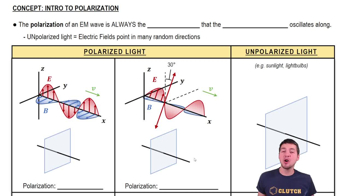
A polarizing filter with vertically aligned chemical molecules only allows light with its electric field oscillating in the vertical direction to pass through, blocking other orientations.
Which field of light is the focus of polarization?
Polarization focuses on the direction in which the electric field of light oscillates.
How is the polarization direction of light represented in a polarization diagram?
It is represented by a double-headed arrow pointing along the direction of the electric field's oscillation. This provides a compact way to indicate the polarization angle.
What happens to the polarization direction of light after it passes through a second polarizer at a different angle?
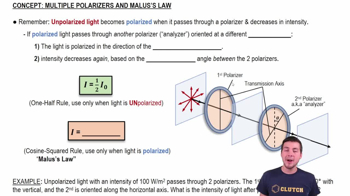
The light becomes polarized along the transmission axis of the second polarizer. Only the component of the electric field parallel to this new axis is transmitted.
When solving problems with multiple polarizers, why is it important to label each intensity (I0, I1, I2, etc.)?
Labeling each intensity helps prevent confusion about which value to use in each step of the calculation. It ensures the correct application of the one-half rule and Malus's Law in sequence.
What is the correct angle to use in Malus's Law when two polarizers are oriented at different angles?
The angle used in Malus's Law is the angle between the transmission axes of the two polarizers, not their individual angles with respect to a reference axis. This distinction is crucial for accurate calculations.
 Back
Back

 05:32
05:32