Back

Power in AC Circuits quiz

Control buttons has been changed to "navigation" mode.
1/15
  • Which circuit element in an AC circuit has a non-zero average power?

    The resistor is the only element with a non-zero average power in an AC circuit.
  • Why do capacitors and inductors have zero average power in AC circuits?

    Because they only store and release energy, so the energy entering equals the energy leaving, resulting in zero average power.
  • How is the maximum power in a resistor calculated in an AC circuit?

    It is calculated as the maximum voltage across the resistor multiplied by the maximum current through it.
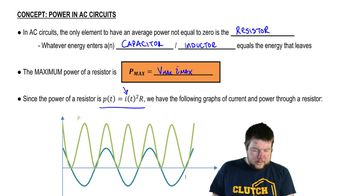
  • What is the formula for instantaneous power in a resistor in terms of current?

    Instantaneous power is the square of the current at that moment times the resistance: P(t) = [I(t)]² × R.
  • Why is the power as a function of time in a resistor always positive?

    Because current is squared in the power formula, making the result always positive regardless of current direction.
  • What is the relationship between average power and maximum power in an AC resistor?

    The average power is half of the maximum power due to the symmetric nature of the power peaks.
  • How do you calculate average power in an AC circuit using maximum values?

    Average power is 1/2 times the maximum voltage times the maximum current: P_avg = 1/2 V_max × I_max.
  • Why can't you use the average values of voltage or current to find average power in AC circuits?

    Because the average values of voltage and current in AC circuits are zero, so they can't be used to calculate average power.
  • What values are used to calculate average power in AC circuits?

    The RMS (root mean square) values of voltage and current are used to calculate average power.
  • What is the formula for average power in terms of RMS values?

    Average power is the product of RMS voltage and RMS current: P_avg = V_rms × I_rms.
  • How do you find the RMS current from the maximum current in an AC circuit?

    RMS current is the maximum current divided by the square root of 2: I_rms = I_max / √2.
  • If an AC source has a maximum voltage of 120 V and is connected to a 10 Ω resistor, what is the maximum current?

    The maximum current is 120 V divided by 10 Ω, which equals 12 A.
  • Using the above values, what is the average power emitted by the resistor?

    The average power is 1/2 × 120 V × 12 A = 720 W.
  • How can you verify the average power using RMS values for the same circuit?

    Calculate I_rms = 12 A / √2 ≈ 8.49 A, then P_avg = (8.49 A)² × 10 Ω = 720 W, matching the previous result.
  • Why does the average power calculation using RMS values match the calculation using maximum values?

    Because the average power in AC circuits is defined in terms of RMS values, which account for the time-varying nature of voltage and current.