What happens to the velocity of a projectile when it is released from a moving vehicle?
The projectile inherits the velocity of the vehicle, which is added to its launch velocity to determine its initial velocity.
How do you calculate the combined velocity of a projectile launched from a moving vehicle?
You use vector addition to combine the vehicle's velocity and the launch velocity, often applying the Pythagorean theorem for perpendicular components.
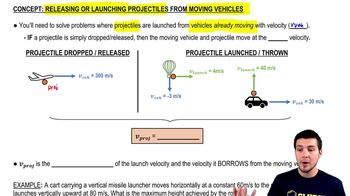
If a plane moving at 300 m/s releases a package, what is the horizontal velocity of the package immediately after release?
The package's horizontal velocity is 300 m/s, the same as the plane's velocity.
What is the initial velocity of a projectile if it is simply dropped from a moving vehicle?
The initial velocity is equal to the velocity of the vehicle, since the launch velocity is zero.
In the example of a balloon moving downward at 3 m/s launching an object outward at 4 m/s, what is the magnitude of the projectile's velocity?
The magnitude is 5 m/s, found using the Pythagorean theorem: sqrt(3^2 + 4^2) = 5.
Why do you use the Pythagorean theorem in projectile problems involving moving vehicles?
Because the velocity components are often perpendicular, and the theorem allows you to find the resultant velocity vector.
What is the formula for the projectile's velocity when launched from a moving vehicle?
The projectile's velocity is the vector sum of the vehicle's velocity and the launch velocity: v_projectile = v_vehicle + v_launch.
If a cart moves at 30 m/s and launches a projectile straight up at 40 m/s, what is the projectile's initial velocity?
The initial velocity is 50 m/s, calculated using the Pythagorean theorem: sqrt(30^2 + 40^2) = 50.
What path does a projectile follow after being launched from a moving vehicle?
It follows a parabolic path, just like any other projectile, but with an initial velocity that combines the vehicle and launch velocities.
In symmetrical launch problems, how do you find the maximum height of a projectile?
You use kinematic equations focusing on the vertical component of the motion, such as v^2 = v0^2 + 2aΔy.
When decomposing the projectile's velocity into components, which component is equal to the launch velocity if launched vertically?
The vertical component (y-direction) is equal to the launch velocity.
What is the vertical velocity of a projectile at the peak of its trajectory in a symmetrical launch?
The vertical velocity at the peak is zero.
If a cart moves at 60 m/s and launches a missile vertically at 80 m/s, what is the magnitude of the missile's initial velocity?
The magnitude is 100 m/s, calculated as sqrt(60^2 + 80^2) = 100.
What is the first step when solving projectile motion problems involving moving vehicles?
The first step is to determine the initial velocity of the projectile by combining the vehicle and launch velocities.
How does the motion of a projectile launched from a moving vehicle compare to one launched from rest?
The motion is similar, except the initial velocity includes the vehicle's velocity, affecting the trajectory and range.
 Back
Back
 07:38
07:38