Skip to main content
Physics with Calculus
My Course
Learn
Exam Prep
AI Tutor
Study Guides
Textbook Solutions
Flashcards
Explore
Try the app
My Course
Learn
Exam Prep
AI Tutor
Study Guides
Textbook Solutions
Flashcards
Explore
Try the app
Back
Radiation Pressure quiz
You can tap to flip the card.
What is radiation pressure and how is it related to electromagnetic waves?
You can tap to flip the card.
👆
What is radiation pressure and how is it related to electromagnetic waves?
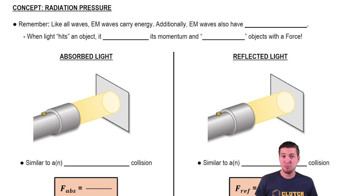
Radiation pressure is the force exerted by electromagnetic waves due to their momentum. It occurs when light is absorbed or reflected by an object.
Track progress
Control buttons has been changed to "navigation" mode.
1/9
Related flashcards
Related practice
Recommended videos
Radiation Pressure definitions
Radiation Pressure
15 Terms
Radiation Pressure
32. Electromagnetic Waves
2 problems
Topic
David-Paige
Polarization & Polarization Filters
32. Electromagnetic Waves
4 problems
Topic
Patrick
32. Electromagnetic Waves
7 topics
8 problems
Chapter
Patrick
Guided course
07:06
Radiation Pressure Example 1
3448
views
31
rank
1
comments
Guided course
07:51
Radiation Pressure
4579
views
41
rank
Guided course
06:29
Radiation Pressure Example 2
3240
views
40
rank
3
comments
Terms in this set (9)
Hide definitions
What is radiation pressure and how is it related to electromagnetic waves?
Radiation pressure is the force exerted by electromagnetic waves due to their momentum. It occurs when light is absorbed or reflected by an object.
How does the force exerted by absorbed light compare to that of reflected light?
Reflected light exerts a greater force than absorbed light because the change in momentum is larger for reflected light.
What is the formula for the force exerted by absorbed light?
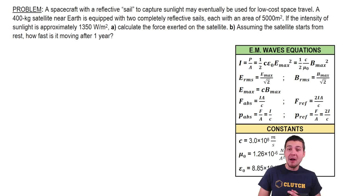
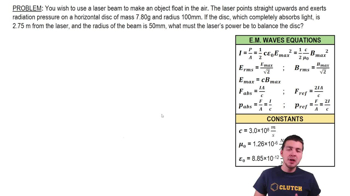
The force exerted by absorbed light is calculated as F absorbed = I*A/C, where I is intensity, A is area, and C is the speed of light.
What is the formula for the force exerted by reflected light?
The force exerted by reflected light is F reflected = 2*I*A/C, which is twice the force of absorbed light due to greater momentum change.
How is radiation pressure defined in terms of force and area?
Radiation pressure is defined as the force per unit area, with P absorbed = I/C for absorbed light and P reflected = 2*I/C for reflected light.
What is the relationship between intensity, power, and area in radiation pressure problems?
Intensity (I) is related to power (P) and area (A) by the formula I = P/A.
How can you calculate the radiation pressure on an object absorbing light?
Radiation pressure for absorbed light can be calculated using P absorbed = I/C, where I is intensity and C is the speed of light.
What is the significance of the speed of light (C) in radiation pressure equations?
The speed of light (C) is a constant used in the denominator of radiation pressure equations, affecting the magnitude of the pressure and force.
Why is the force exerted by a laser on a hand considered very small?
The force is very small because the intensity and area involved are small, resulting in a minimal pressure and force exerted by the laser.
 BackBack

 07:06
07:06