Refraction of Light & Snell's Law definitions Flashcards

Refraction of Light & Snell's Law definitions
Control buttons has been changed to "navigation" mode.
1/15
  • Refraction
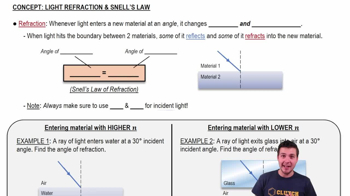
    Phenomenon where light changes speed and direction when entering a new material at an angle.
  • Snell's Law
    Equation relating the indices of refraction and angles of incidence and refraction: N1 * sin(theta1) = N2 * sin(theta2).
  • Index of Refraction
    Measure of how much a material reduces the speed of light, affecting the angle of refraction.
  • Angle of Incidence
    Angle between the incoming light ray and the normal to the surface at the point of incidence.
  • Angle of Refraction
    Angle between the refracted light ray and the normal to the surface in the new medium.
  • Normal
    Imaginary line perpendicular to the boundary between two different media where refraction occurs.
  • Medium
    Material through which light travels, affecting its speed and direction.
  • Incident Light
    Light ray that strikes a surface before refraction or reflection occurs.
  • Outgoing Light
    Light ray that emerges after refraction, having changed direction and speed.
  • Inverse Sine
    Mathematical function used to determine an angle from its sine value, often used in Snell's Law.
  • Higher Index
    Condition where light enters a medium with a greater index of refraction, bending towards the normal.
  • Lower Index
    Condition where light enters a medium with a lesser index of refraction, bending away from the normal.
  • Boundary
    Interface between two different media where refraction or reflection of light occurs.
  • Sine
    Trigonometric function used in Snell's Law to relate angles of incidence and refraction.
  • Theta
    Symbol commonly used to represent angles in mathematical equations, such as in Snell's Law.