Skip to main content
Physics with Calculus
My Course
Learn
Exam Prep
AI Tutor
Study Guides
Textbook Solutions
Flashcards
Explore
Try the app
My Course
Learn
Exam Prep
AI Tutor
Study Guides
Textbook Solutions
Flashcards
Explore
Try the app
Back
Relationships Between Force, Field, Energy, Potential quiz
You can tap to flip the card.
What is the relationship between electric force (F) and electric field (E)?
You can tap to flip the card.
👆
What is the relationship between electric force (F) and electric field (E)?
Electric force is given by F = Q * E, where Q is the charge experiencing the force in the electric field E.
Track progress
Control buttons has been changed to "navigation" mode.
1/15
Related flashcards
Related practice
Recommended videos
Relationships Between Force, Field, Energy, Potential definitions
Relationships Between Force, Field, Energy, Potential
15 Terms
Relationships Between Force, Field, Energy, Potential
25. Electric Potential
6 problems
Topic
Patrick
The ElectronVolt
25. Electric Potential
3 problems
Topic
Patrick
25. Electric Potential - Part 1 of 2
6 topics
15 problems
Chapter
Patrick
25. Electric Potential - Part 2 of 2
2 topics
6 problems
Chapter
Guided course
03:43
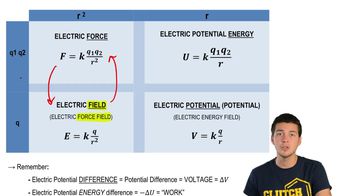
Relationships Between Force, Field, Energy, Potential
12932
views
201
rank
4
comments
Guided course
07:12
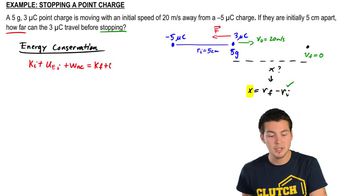
Distance to Stop a Point Charge
6930
views
111
rank
3
comments
Guided course
03:56
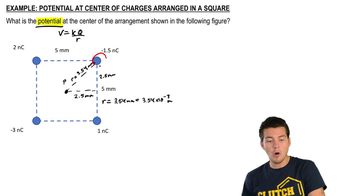
Potential at Center of Charges in a Square
8614
views
138
rank
1
comments
Terms in this set (15)
Hide definitions
What is the relationship between electric force (F) and electric field (E)?
Electric force is given by F = Q * E, where Q is the charge experiencing the force in the electric field E.
What does the electric field (E) represent in terms of charges?
The electric field is a force field set up by a charge that another charge can feel and experience a force from.
How is electric potential energy (U) related to electric potential (V)?
Electric potential energy is given by U = Q * V, where Q is the charge and V is the electric potential at its location.
What is the formula for the work done in terms of potential energy?
The negative change in potential energy, -ΔU, is equal to the work done, which is F * Δr.
How is the change in electric potential (ΔV) related to the electric field (E)?
The negative change in electric potential, -ΔV, is equal to E * Δr, where Δr is the distance moved in the field.
What does the variable Δr represent in these equations?
Δr represents a distance variable, which can also be written as Δx or Δd, depending on the context.
What is the physical meaning of electric potential (V)?
Electric potential tells other charges how much energy they possess at a certain location.
What is voltage in terms of electric potential?
Voltage is the potential difference between two points, represented as ΔV.
How should you interpret the notation for charges in formulas?
You must identify which charge is producing the field and which is experiencing the force, as notation varies between professors.
What is the relationship between force and potential energy?
The negative change in potential energy is equal to the force times the distance moved, -ΔU = F * Δr.
What is the relationship between electric field and voltage?
The negative change in voltage is equal to the electric field times the distance, -ΔV = E * Δr.
What is the significance of the negative sign in the equations for work and voltage?
The negative sign indicates that work is done against the potential energy or potential difference.
What is the difference between the producing charge and the feeling charge?
The producing charge sets up the field or potential, while the feeling charge experiences the force or energy from it.
Why is it important to keep track of which charge is which in equations?
Different professors may use different notations, so you must know which charge is responsible for the field and which is affected by it.
What are the four key concepts discussed in the video?
The four key concepts are electric force, electric field, electric potential energy, and electric potential.
 BackBack
 03:43
03:43