Back

RMS Current and Voltage quiz

Control buttons has been changed to "navigation" mode.
1/15
  • Why are RMS values more useful than average values in AC circuits?

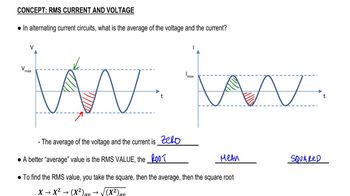
    Because the average values of voltage and current in AC circuits are zero due to their symmetrical positive and negative peaks, making RMS values a better measure of effective magnitude.
  • What does RMS stand for in the context of AC circuits?

    RMS stands for Root Mean Squared.
  • Describe the three steps to calculate the RMS value of a quantity.

    First, square the quantity; second, take the mean (average) of the squared values; third, take the square root of that mean.
  • What is the mathematical relationship between maximum voltage and RMS voltage in an AC circuit?

    Vmax = sqrt(2) × VRMS.
  • How do you calculate the maximum current from the RMS current in an AC circuit?

    Imax = sqrt(2) × IRMS.
  • If the RMS voltage of a U.S. outlet is 120 V, what is the maximum voltage?

    The maximum voltage is approximately 170 V.
  • Why is the average value of current or voltage in an AC circuit always zero?

    Because the positive and negative peaks are symmetrical and cancel each other out over a full cycle.
  • What is the formula for finding the maximum current through a resistor in an AC circuit?

    The maximum current is Imax = Vmax / R, where Vmax is the maximum voltage and R is the resistance.
  • Given a 12-ohm resistor connected to a 120 V RMS AC source, what is the maximum current?

    The maximum current is about 14.2 amps.
  • How do you calculate the RMS current if you know the maximum current?

    Divide the maximum current by the square root of 2: IRMS = Imax / sqrt(2).
  • What is the RMS current through a 12-ohm resistor connected to a 120 V RMS AC source?

    The RMS current is approximately 10 amps.
  • Why must you square the quantity before averaging when calculating RMS?

    Because averaging first would result in zero for AC signals, so squaring ensures all values are positive before averaging.
  • What does the 'root' in 'root mean squared' refer to?

    It refers to taking the square root of the mean of the squared values.
  • In the context of AC circuits, what does a graph of voltage or current versus time look like?

    It alternates symmetrically above and below the horizontal axis, representing positive and negative peaks.
  • What is the significance of using RMS values in Ohm's law for AC circuits?

    RMS values allow you to use Ohm's law (V = IR) in AC circuits as if you were dealing with constant DC values.