Back

Rotational Dynamics of Rolling Motion quiz

Control buttons has been changed to "navigation" mode.
1/15
  • What is meant by 'rolling motion' in rotational dynamics?

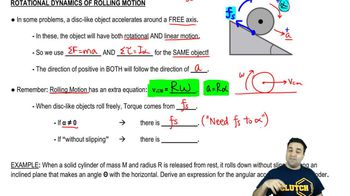
    Rolling motion refers to an object rotating around its axis while its axis itself moves, combining both rotational and linear motion.
  • What key equation relates the velocity at the center of mass to angular velocity in rolling motion?

    The equation is V_cm = R * omega, where V_cm is the velocity at the center of mass, R is the radius, and omega is the angular velocity.
  • Which force provides the torque necessary for angular acceleration in rolling objects?

    Static friction provides the torque necessary for angular acceleration (alpha) in rolling objects.
  • Why is static friction essential for angular acceleration in rolling motion?

    Without static friction, there would be no torque and thus no angular acceleration (alpha); static friction is required to start or stop spinning.
  • What does 'rolling without slipping' imply about the types of friction present?

    'Rolling without slipping' means that only static friction is present and kinetic friction is absent.
  • What is the equation relating linear acceleration and angular acceleration in rolling motion?

    The equation is a = R * alpha, where a is linear acceleration, R is the radius, and alpha is angular acceleration.
  • When analyzing a rolling object, which two Newtonian equations are typically used?

    You use the sum of all forces equals ma (F = ma) and the sum of all torques equals I * alpha (torque = I * alpha).
  • In the example of a solid cylinder rolling down an incline, what is the moment of inertia used?

    The moment of inertia for a solid cylinder is (1/2) m R^2.
  • How do you express the torque due to static friction for a rolling object?

    The torque due to static friction is always the friction force multiplied by the radius (torque = F_friction * R).
  • What is the derived formula for the linear acceleration of a solid cylinder rolling down an incline?

    The linear acceleration is a = (2/3) g sin(theta), where g is gravity and theta is the incline angle.
  • How does the acceleration of a rolling object compare to a block sliding without friction down the same incline?

    The rolling object's acceleration is less than that of a sliding block because some energy goes into rotational motion.
  • What is the final formula for angular acceleration (alpha) for a solid cylinder rolling down an incline?

    Alpha = (2g sin(theta)) / (3R), where g is gravity, theta is the incline angle, and R is the radius.
  • Why should you avoid expanding static friction into mu*normal in rolling motion problems?

    Because static friction acts to connect the force and torque equations, and expanding it is unnecessary for solving the system.
  • What happens to the mass variable when solving for acceleration in a single-object rolling problem?

    The mass cancels out because it appears in both the force and torque equations for the same object.
  • How can you check if your derived acceleration formula for rolling motion is reasonable?

    Compare it to the linear case (a = g sin(theta)); the rolling case should yield a smaller value, indicating energy is shared with rotation.