Back

Series LRC Circuits quiz

Control buttons has been changed to "navigation" mode.
1/15
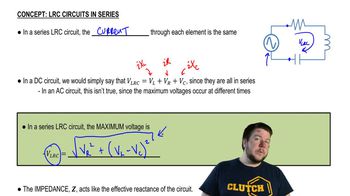
  • What components make up a series LRC circuit?

    A series LRC circuit is made up of an inductor, a resistor, and a capacitor connected in series to an AC source.
  • In a series LRC circuit, how does the current behave through each component?

    The current through each component is the same in a series LRC circuit.
  • Why can't you simply add the maximum voltages across each element in a series LRC circuit?

    You can't simply add them because the voltage peaks at different times for each component in an AC circuit.
  • What is the formula for the maximum voltage in a series LRC circuit?

    The maximum voltage is the square root of the sum of the square of the voltage across the resistor and the square of the difference between the voltages across the inductor and the capacitor.
  • What does impedance represent in a series LRC circuit?

    Impedance acts as the effective resistance (or reactance) of the circuit, determining how much current the source can produce.
  • How do you calculate the maximum current in a series LRC circuit?

    The maximum current is found by dividing the maximum voltage by the impedance of the circuit.
  • How do you convert RMS voltage to maximum voltage in AC circuits?

    Multiply the RMS voltage by the square root of 2 to get the maximum voltage.
  • How do you convert linear frequency to angular frequency?

    Multiply the linear frequency by 2π to get the angular frequency.
  • What is the formula for impedance in a series LRC circuit?

    Impedance is the square root of the resistance squared plus the square of the difference between the inductive reactance and the capacitive reactance.
  • What is the equation for inductive reactance?

    Inductive reactance is calculated as the angular frequency times the inductance (ωL).
  • What is the equation for capacitive reactance?

    Capacitive reactance is calculated as 1 divided by the product of angular frequency and capacitance (1/ωC).
  • In the example, why is 377 used instead of 60 for frequency in calculations?

    377 is the angular frequency (2π × 60 Hz), which is required for reactance calculations, not the linear frequency.
  • If the RMS voltage is 120 V, what is the maximum voltage?

    The maximum voltage is about 170 V, calculated as 120 V times the square root of 2.
  • What is the impedance if R = 10 Ω, L = 0.5 H, C = 500 μF, and ω = 377 s⁻¹?

    The impedance is 183 Ω, calculated using the impedance formula with the given values.
  • What is the maximum current if the maximum voltage is 170 V and the impedance is 183 Ω?

    The maximum current is 0.93 A, found by dividing 170 V by 183 Ω.