Physics
My Course
Learn
Exam Prep
AI Tutor
Study Guides
Textbook Solutions
Flashcards
Explore
My Course
Learn
Exam Prep
AI Tutor
Study Guides
Textbook Solutions
Flashcards
Explore
Back
Solving Capacitor Circuits quiz
You can tap to flip the card.
Define:
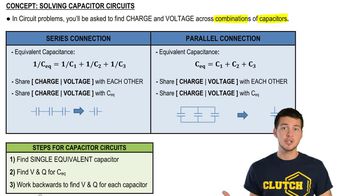
What is the rule for finding equivalent capacitance in a series connection of capacitors?
You can tap to flip the card.
👆
What is the rule for finding equivalent capacitance in a series connection of capacitors?
Use the inverse sum rule: the inverse of the equivalent capacitance equals the sum of the inverses of individual capacitances.
Track progress
Control buttons has been changed to "navigation" mode.
1/15
Related flashcards
Related practice
Recommended videos
Solving Capacitor Circuits definitions
Solving Capacitor Circuits
15 Terms
Solving Capacitor Circuits
26. Capacitors & Dielectrics
4 problems
Topic

Patrick
Intro To Dielectrics
26. Capacitors & Dielectrics
3 problems
Topic
Patrick
26. Capacitors & Dielectrics - Part 1 of 2
4 topics
8 problems
Chapter
Patrick
26. Capacitors & Dielectrics - Part 2 of 2
3 topics
6 problems
Chapter
Patrick
Guided course
11:02
Solving Capacitor Circuits
Patrick
8838
views
158
rank
5
comments
Guided course
02:25
Find Charge of One Capacitor (Simple)
Patrick
5100
views
93
rank
2
comments
Terms in this set (15)
Hide definitions
What is the rule for finding equivalent capacitance in a series connection of capacitors?
Use the inverse sum rule: the inverse of the equivalent capacitance equals the sum of the inverses of individual capacitances.
How do capacitors in series share charge?
Capacitors in series all have the same charge, which is also the charge on the equivalent capacitance.
What is the rule for finding equivalent capacitance in a parallel connection of capacitors?
The equivalent capacitance is the sum of the individual capacitances.
What do capacitors in parallel share with each other?
Capacitors in parallel share the same voltage across each capacitor.
What is the relationship between charge (Q), capacitance (C), and voltage (V) in a capacitor?
The relationship is Q = C × V.
What is the first step in solving a capacitor circuit problem?
Find the single equivalent capacitance for the entire circuit.
After finding the equivalent capacitance, what should you determine next?
Determine the voltage and charge across the equivalent capacitor using Q = C × V.
How do you find the charge on each capacitor in a series configuration?
Each capacitor in series has the same charge as the equivalent capacitance.
How do you find the voltage across each capacitor in a series configuration?
Use V = Q / C for each capacitor, where Q is the shared charge and C is the individual capacitance.
How do you find the voltage across each capacitor in a parallel configuration?
Each capacitor in parallel has the same voltage as the equivalent capacitance.
How do you find the charge on each capacitor in a parallel configuration?
Use Q = C × V for each capacitor, where V is the shared voltage and C is the individual capacitance.
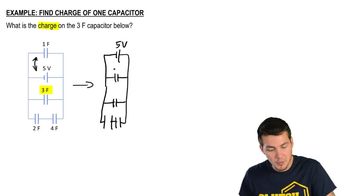
In the example circuit, what is the equivalent capacitance of a 1 farad and 2 farad capacitor in parallel?
The equivalent capacitance is 1 + 2 = 3 farads.
How do you combine a 6 farad capacitor in series with a 3 farad equivalent capacitor?
Use the formula: (6 × 3) / (6 + 3) = 2 farads for the equivalent capacitance.
If the total voltage across the circuit is 10 volts and the equivalent capacitance is 2 farads, what is the total charge?
The total charge is Q = 2 × 10 = 20 coulombs.
What is the voltage across a 6 farad capacitor in series with a 3 farad equivalent capacitor, given a shared charge of 20 coulombs?
The voltage is V = Q / C = 20 / 6 = 3.33 volts.