Skip to main content
Physics with Calculus
My Course
Learn
Exam Prep
AI Tutor
Study Guides
Textbook Solutions
Flashcards
Explore
Try the app
My Course
Learn
Exam Prep
AI Tutor
Study Guides
Textbook Solutions
Flashcards
Explore
Try the app
Back
Solving Density Problems quiz
You can tap to flip the card.
What is the formula for density?
You can tap to flip the card.
👆
What is the formula for density?
Density is defined as mass divided by volume, or ρ = m / V.
Track progress
Control buttons has been changed to "navigation" mode.
1/15
Related flashcards
Related practice
Recommended videos
Solving Density Problems definitions
Solving Density Problems
15 Terms
Solving Density Problems
1. Intro to Physics Units
5 problems
Topic
Patrick
Dimensional Analysis
1. Intro to Physics Units
4 problems
Topic
Patrick
1. Intro to Physics Units
6 topics
14 problems
Chapter
Patrick
Guided course
03:13
Finding the Side Length of a Cube
6644
views
105
rank
2
comments
Guided course
04:33
Problems with Mass, Volume, & Density
11758
views
197
rank
Terms in this set (15)
Hide definitions
What is the formula for density?
Density is defined as mass divided by volume, or ρ = m / V.
What is the SI unit for density?
The SI unit for density is kilograms per cubic meter (kg/m^3).
Which Greek letter is commonly used to represent density?
Density is represented by the Greek letter rho (ρ).
How do you rearrange the density formula to solve for mass?
To solve for mass, rearrange the formula to m = ρ × V.
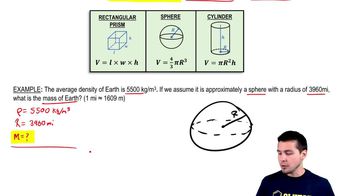
What is the formula for the volume of a sphere?
The volume of a sphere is V = (4/3) × π × r^3, where r is the radius.
Why is it important to convert the radius of the Earth from miles to meters in density problems?
It's important to convert to meters to ensure all units are consistent with the SI system for accurate calculations.
What is the conversion factor from miles to meters?
1 mile is equal to 1609 meters.
If the radius of the Earth is 3960 miles, what is it in meters?
The radius in meters is 3960 × 1609 = 6.37 × 10^6 meters.
What is the average density of the Earth used in the example?
The average density of the Earth used is 55100 kg/m^3.
After converting the radius to meters, what is the next step in finding the Earth's mass?
The next step is to calculate the Earth's volume using the sphere volume formula.
What is the calculated volume of the Earth in the example?
The calculated volume is 1.08 × 10^21 m^3.
How do you find the mass of the Earth once you have its density and volume?
Multiply the density by the volume: mass = density × volume.
What is the calculated mass of the Earth in the example?
The calculated mass is 5.94 × 10^24 kg.
Why might the calculated mass of the Earth differ slightly from the actual value?
The difference is due to rounding in the calculations.
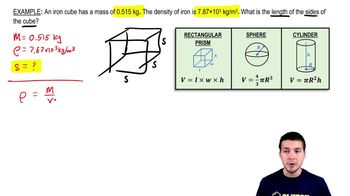
What are the three main variables related in density problems?
The three main variables are density, mass, and volume.
 BackBack
 03:13
03:13