A material medium (solid, liquid, or gas) is required for a sound wave to travel, as sound propagates by vibrating particles.
What does the amplitude of a sound wave measure?
The amplitude of a sound wave measures the maximum displacement of air particles from their rest position, which is related to the loudness or volume of the sound.
Which characteristic of a wave is related to the intensity or loudness of a sound?
The amplitude of a sound wave is related to its intensity or loudness.
What factors affect the speed of sound?
The speed of sound is affected by the properties of the medium, such as its density and temperature.
Why do sound waves move faster through the ground than through the air?
Sound waves move faster through the ground than through the air because solids have particles that are closer together, allowing vibrations to transfer more quickly.
What is the unit of measure that describes the intensity or loudness of a sound?
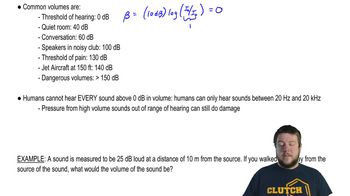
The decibel (dB) is the unit used to describe the intensity or loudness of a sound.
How is sound created?
Sound is created by vibrating objects, which cause the surrounding medium's particles to vibrate and transmit the sound wave.
What is an example of electric energy being converted to sound energy?
A speaker converts electric energy into sound energy by vibrating a diaphragm to produce sound waves.
What ultimately happens to the energy of sound in the air?
The energy of sound in the air is eventually absorbed by the medium and converted into other forms of energy, such as heat.
What characteristic will a note with a high pitch also have?
A note with a high pitch will have a high frequency.
Which characteristic of a sound wave represents its volume?
The amplitude of a sound wave represents its volume.
How is the amplitude of a sound wave related to the loudness of the sound?
The greater the amplitude of a sound wave, the louder the sound.
In a sound wave, what refers to the extent to which air particles are displaced?
The amplitude refers to the extent to which air particles are displaced in a sound wave.
What is the difference between a sound measuring 50 dB and another sound measuring 100 dB?
A sound at 100 dB is 100,000 times more intense than a sound at 50 dB, due to the logarithmic nature of the decibel scale.
Which property of sound is most similar to the brightness of light?
The intensity (or amplitude) of sound is most similar to the brightness of light.
To what property of a sound wave is a sound’s volume related?
A sound's volume is related to the amplitude of the sound wave.
What characteristic of sound refers to the number of wave cycles that occur in a second?
The frequency of a sound wave refers to the number of wave cycles that occur in a second.
To what property of a sound wave is a sound's volume related?
A sound's volume is related to the amplitude of the sound wave.
On what does the amplitude of a sound wave depend?
The amplitude of a sound wave depends on the energy of the vibrating source.
What is the frequency of a sound at 100 Hz?
The frequency of the sound is 100 Hz, meaning 100 wave cycles occur per second.
What is a reflected sound wave called?
A reflected sound wave is called an echo.
Through which medium is it impossible to transmit sound waves?
It is impossible to transmit sound waves through a vacuum, as there are no particles to vibrate.
Through what types of media can sound travel?
Sound can travel through solids, liquids, and gases.
Which sound wave would make a louder sound: one with higher or lower amplitude?
A sound wave with higher amplitude would make a louder sound.
What behavior of sound waves causes echoes?
Reflection of sound waves from a surface causes echoes.
When a sound is louder, what measurement gets bigger?
When a sound is louder, its amplitude and intensity increase.
What determines the pitch of a sound?
The pitch of a sound is determined by its frequency.
How do the vibrations of the sound source compare for louder versus softer sounds?
Louder sounds are produced by vibrations with greater amplitude.
What type of wave moves through matter and vibrates our eardrums?
A longitudinal (compression) wave moves through matter and vibrates our eardrums.
Which property of a sound wave indicates volume?
The amplitude of a sound wave indicates its volume.
How is sound intensity defined in terms of energy and time?
Sound intensity is the amount of power (energy per second) carried by a sound wave per unit area.
What allows us to hear the loudness of a sound?
The amplitude and intensity of a sound wave allow us to perceive its loudness.
Which scale is used to measure the intensity of sound?
The decibel (dB) scale is used to measure the intensity of sound.
What refers to the highness or lowness of a sound?
The pitch of a sound refers to its highness or lowness.
What increases as sound waves increase in frequency?
As sound waves increase in frequency, their pitch increases.
Why will sound not travel in a vacuum?
Sound will not travel in a vacuum because there are no particles to transmit the vibrations.
How does sound energy move?
Sound energy moves by causing particles in a medium to vibrate and transfer energy from one particle to another.
On which wave property does the loudness of a sound depend?
The loudness of a sound depends on the amplitude of the sound wave.
Which technology uses sound waves to locate underwater objects?
Sonar uses sound waves to locate underwater objects.
Which units are used to express sound intensity?
Sound intensity is expressed in watts per square meter (W/m²).
 Back
Back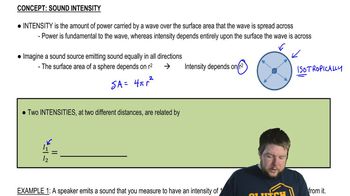
 07:13
07:13