Skip to main content
Physics with Calculus
My Course
Learn
Exam Prep
AI Tutor
Study Guides
Textbook Solutions
Flashcards
Explore
Try the app
My Course
Learn
Exam Prep
AI Tutor
Study Guides
Textbook Solutions
Flashcards
Explore
Try the app
Back
Special Equations in Symmetrical Launches quiz
You can tap to flip the card.
What is a symmetrical launch in projectile motion?
You can tap to flip the card.
👆
What is a symmetrical launch in projectile motion?
A symmetrical launch is when the projectile's final height equals its initial height, making the motion symmetric about the peak.
Track progress
Control buttons has been changed to "navigation" mode.
1/15
Related flashcards
Related practice
Recommended videos
Special Equations in Symmetrical Launches definitions
Special Equations in Symmetrical Launches
15 Terms
Special Equations in Symmetrical Launches
5. Projectile Motion
1 problem
Topic
Positive (Upward) Launch
5. Projectile Motion
6 problems
Topic
Patrick
5. Projectile Motion
6 topics
14 problems
Chapter
Patrick
Guided course
03:34
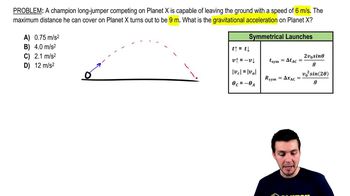
A Long Jump on Planet X
4182
views
38
rank
2
comments
Guided course
07:51
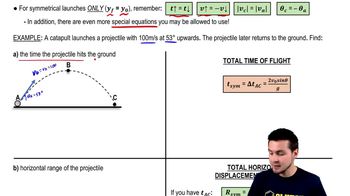
Using Special Equations in Symmetrical Launch Problems
6878
views
69
rank
2
comments
Terms in this set (15)
Hide definitions
What is a symmetrical launch in projectile motion?
A symmetrical launch is when the projectile's final height equals its initial height, making the motion symmetric about the peak.
What is the relationship between the time to ascend and the time to descend in a symmetrical launch?
The time to ascend equals the time to descend in a symmetrical launch.
How does the initial upward velocity compare to the final downward velocity in a symmetrical launch?
The initial upward velocity is equal in magnitude but opposite in direction to the final downward velocity.
What is the special equation for total time of flight in a symmetrical launch?
The total time of flight is T = 2 * V0 * sin(theta) / g, where V0 is initial velocity, theta is launch angle, and g is gravity.
When can you use the equation T = 2 * V0 * sin(theta) / g?
You can use this equation only for symmetrical launches where the projectile lands at the same height it was launched.
How do you calculate the horizontal range if you already know the total time of flight?
The horizontal range R is calculated as R = Vx * T, where Vx is the horizontal velocity and T is the total time of flight.
What is the range equation for a symmetrical projectile launch?
The range equation is R = V0^2 * sin(2*theta) / g.
What is the x-component of the initial velocity in projectile motion?
The x-component is V0 * cos(theta), where V0 is the initial velocity and theta is the launch angle.
At what launch angle is the horizontal range of a projectile maximized?
The horizontal range is maximized at a launch angle of 45 degrees.
What are complementary launch angles in projectile motion?
Complementary launch angles are two angles that add up to 90 degrees, such as 30° and 60°.
How do complementary angles affect the range of a projectile?
For the same initial velocity, complementary angles yield the same horizontal range.
If a projectile is launched at 53°, what other angle will give the same range?
The complementary angle, 37°, will give the same range because 53° + 37° = 90°.
What is the horizontal range if V0 = 100 m/s and theta = 53° or 37°?
The horizontal range is 980 meters for both angles.
Why do the equations R = Vx * T and R = V0^2 * sin(2*theta) / g give the same result?
Both equations are derived from the same principles and are equivalent for symmetrical launches.
What must be true about the initial and final heights to use the special symmetrical launch equations?
The initial and final heights must be equal for the special symmetrical launch equations to apply.
 BackBack
 03:34
03:34