Back

Standing Wave Functions quiz

Control buttons has been changed to "navigation" mode.
1/15
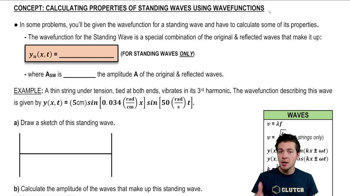
  • What is the general form of the wave function for a standing wave?

    The general form is y(x, t) = ASW * sin(kx) * sin(ωt), where ASW is the amplitude, k is the wave number, and ω is the angular frequency.
  • How does the amplitude of a standing wave (ASW) relate to the amplitudes of the original and reflected waves?

    The amplitude of the standing wave is twice the amplitude of the original and reflected waves that form it.
  • If the amplitude of a standing wave is 5 cm, what is the amplitude of each individual wave that forms it?

    Each individual wave has an amplitude of 2.5 cm, which is half of the standing wave's amplitude.
  • How many loops (antinodes) are present in the 3rd harmonic (n=3) of a standing wave on a string?

    There are 3 loops (antinodes) in the 3rd harmonic.
  • How many nodes are present in the 3rd harmonic of a standing wave?

    There are 4 nodes in the 3rd harmonic.
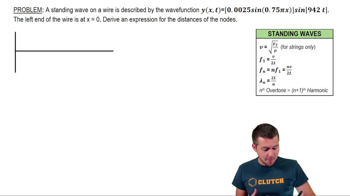
  • What is the relationship between the length of the string (L), the harmonic number (n), and the wavelength (λn)?

    The relationship is L = n * λn / 2.
  • How do you calculate the wavelength (λ) from the wave number (k)?

    The wavelength is given by λ = 2π / k.
  • Given k = 0.034, what is the wavelength of the standing wave?

    The wavelength is approximately 185 cm, calculated as λ = 2π / 0.034.
  • How do you calculate the period of oscillation (T) from the angular frequency (ω)?

    The period is T = 2π / ω.
  • If ω = 50 radians/second, what is the period of oscillation?

    The period is 1.3 seconds, calculated as T = 2π / 50.
  • What does the standing wave function y(x, t) = ASW * sin(kx) * sin(ωt) represent physically?

    It represents the displacement of points on the string as a function of position and time for a standing wave.
  • What is the value of n for the 3rd harmonic, and what does it signify?

    n = 3, which signifies the number of loops (antinodes) in the standing wave.
  • How do you rearrange the formula λn = 2L / n to solve for L?

    Rearrange to get L = n * λn / 2.
  • If the string is vibrating in its 3rd harmonic with λ = 185 cm, what is the length of the string?

    The length is 278 cm, calculated as L = 3 * 185 / 2.
  • What is the physical meaning of nodes and antinodes in a standing wave?

    Nodes are points of zero displacement, while antinodes are points of maximum displacement in the standing wave.