Physics
My Course
Learn
Exam Prep
AI Tutor
Study Guides
Textbook Solutions
Flashcards
Explore
My Course
Learn
Exam Prep
AI Tutor
Study Guides
Textbook Solutions
Flashcards
Explore
Back
Standing Waves definitions
1 student found this helpful
You can tap to flip the card.
Standing Wave
You can tap to
flip the card.
👆
Standing Wave
A wave pattern that appears stationary, formed by interference of two waves traveling in opposite directions.
Track progress
Control buttons has been changed to "navigation" mode.
1/15
Related practice
Recommended videos
Guided course
07:58
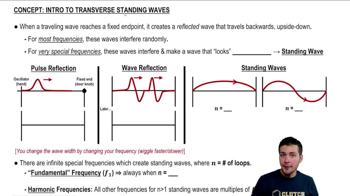
Intro to Transverse Standing Waves
Patrick
4747
views
89
rank
1
comments
Guided course
06:28
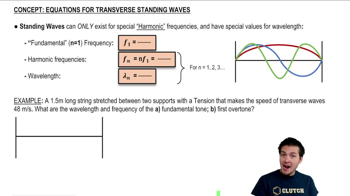
Equations for Transverse Standing Waves
Patrick
3561
views
54
rank
Guided course
05:28
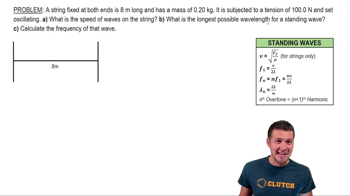
Example 1
Patrick
2640
views
39
rank
1
comments
Terms in this set (15)
Hide definitions
Standing Wave
A wave pattern that appears stationary, formed by interference of two waves traveling in opposite directions.
Transverse Wave
A wave in which particles of the medium move perpendicular to the direction of the wave.
Fundamental Frequency
The lowest frequency at which a system oscillates, corresponding to n=1 in standing waves.
Harmonic
A frequency that is a whole number multiple of the fundamental frequency.
Overtone
A frequency higher than the fundamental frequency, with the first overtone being the second harmonic.
Wavelength
The distance between two consecutive points in phase on a wave, such as crest to crest.
Loop
A segment of a standing wave where the wave appears to be stationary, corresponding to a node and antinode.
Node
A point along a standing wave where the wave has minimal amplitude.
Antinode
A point where the amplitude of a standing wave is at its maximum.
Wave Speed
The speed at which a wave travels through a medium, calculated as frequency times wavelength.
Frequency
The number of complete oscillations a wave makes per unit time, measured in Hertz (Hz).
Pulse
A single disturbance that moves through a medium, such as a single wave crest.
Reflection
The change in direction of a wave when it bounces off a surface, such as a fixed endpoint.
Inversion
The flipping of a wave's amplitude upon reflection from a fixed boundary.
Superposition
The principle that the net displacement of a medium is the sum of individual wave displacements.