Physics
My Course
Learn
Exam Prep
AI Tutor
Study Guides
Textbook Solutions
Flashcards
Explore
My Course
Learn
Exam Prep
AI Tutor
Study Guides
Textbook Solutions
Flashcards
Explore
Back
Superposition of Wave Functions quiz
You can tap to flip the card.
Define:
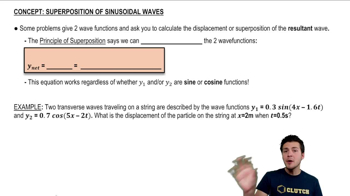
What does the principle of superposition state about wave functions?
You can tap to flip the card.
👆
What does the principle of superposition state about wave functions?
It states that wave functions can be added together to find the resultant wave.
Track progress
Control buttons has been changed to "navigation" mode.
1/15
Related flashcards
Related practice
Recommended videos
Superposition of Wave Functions definitions
Superposition of Wave Functions
15 Terms
Standing Waves
18. Waves & Sound
6 problems
Topic

Patrick
18. Waves & Sound - Part 1 of 3
6 topics
11 problems
Chapter
Patrick
18. Waves & Sound - Part 2 of 3
4 topics
10 problems
Chapter
Patrick
18. Waves & Sound - Part 3 of 3
5 topics
10 problems
Chapter
Patrick
Guided course
03:32
Superposition of Sinusoidal Wave Functions
Patrick
1552
views
11
rank
Terms in this set (15)
Hide definitions
What does the principle of superposition state about wave functions?
It states that wave functions can be added together to find the resultant wave.
How do you find the net wave function if you have two wave functions y1 and y2?
You simply add the two wave functions: y_net = y1 + y2.
Can the two wave functions being added have different amplitudes, wave numbers, or frequencies?
Yes, they can have different amplitudes, wave numbers, or frequencies.
Does the principle of superposition apply to both sine and cosine wave functions?
Yes, it applies to any combination of sine and cosine wave functions.
What is the general form of a wave function used in the example?
The general form is y = A sin(kx ± ωt) or y = A cos(kx ± ωt).
If you are given y1 = 0.3 sin(4x - 1.6t) and y2 = 0.7 cos(5x - 2t), how do you write the net wave function?
The net wave function is y_net = 0.3 sin(4x - 1.6t) + 0.7 cos(5x - 2t).
How do you calculate the displacement at a specific position x and time t using the net wave function?
You substitute the given x and t values into the net wave function and compute the result.
What is the displacement from the sine part when x = 2 and t = 0.5 in the example?
The displacement from the sine part is 0.24.
What is the displacement from the cosine part when x = 2 and t = 0.5 in the example?
The displacement from the cosine part is -0.64.
What is the final net displacement at x = 2 and t = 0.5 for the given wave functions?
The final net displacement is -0.4.
What is a recommended strategy to avoid calculator mistakes when adding wave functions?
Calculate each wave function separately before adding them together.
Is it necessary for the two wave functions to be of the same type (both sine or both cosine) to use superposition?
No, they can be any combination of sine and cosine.
What mathematical operation is used to combine the displacements from two wave functions at a point?
The displacements are added together.
What does the net displacement represent in the context of superposition?
It represents the total displacement of the particle due to both wave functions at a specific position and time.
Why is it important to substitute the correct x and t values into each wave function?
Because each wave function may have different coefficients for x and t, affecting the final displacement calculation.