Back

Advanced Calorimetry: Equilibrium Temperature with Phase Changes quiz

Control buttons has been changed to "navigation" mode.
1/15
  • What is the first step you should take before writing calorimetry equations in a problem involving phase changes?

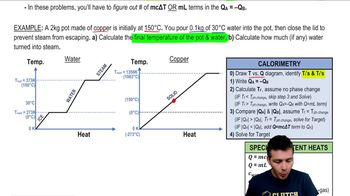
    Draw diagrams to visualize the initial and possible final temperatures of all substances involved.
  • Why can't copper undergo a phase change in the example discussed?

    Copper's melting point is much higher than the temperatures involved, so it only changes temperature, not phase.
  • What are the three possible outcomes for water when mixed with hot copper in a calorimetry problem?

    Water could only increase in temperature, start to boil and partially turn to steam, or fully convert to steam and continue heating as steam.
  • Why is trial and error necessary in advanced calorimetry problems with unknown final temperatures?

    Because you must test different scenarios to determine which calorimetry terms (temperature change, phase change, or both) are needed.
  • What does it mean if your calculated final temperature exceeds 100°C in a water-copper calorimetry problem?

    It means your initial assumption was incorrect, and a phase change (boiling) must be considered.
  • What equation is used to account for the phase change from water to steam?

    The equation q = mL, where L is the latent heat of vaporization, is used for the phase change.
  • How do you determine if all the water turns to steam or only part of it in a calorimetry problem?

    Compare the heat available from the cooling substance to the heat required for all the water to vaporize; if not enough heat is available, only part of the water turns to steam.
  • What is the equilibrium temperature when only some water turns to steam in the example problem?

    The equilibrium temperature is 100°C, the boiling point of water.
  • How do you calculate the partial mass of water that turns into steam?

    Set up a heat balance equation including both the temperature change and the phase change, then solve for the mass that vaporizes.
  • What is the significance of the latent heat of vaporization in these problems?

    It represents the energy required to convert water at 100°C to steam at 100°C without changing temperature.
  • Why is it important to check the sign of heat values in calorimetry equations?

    Because heat lost by one substance is gained by another, so correct signs ensure energy conservation.
  • What does a negative value for QB (heat lost by copper) indicate?

    It indicates that copper is losing heat as it cools down.
  • What is the specific heat equation used for temperature changes in calorimetry?

    The equation is q = mcΔT, where m is mass, c is specific heat, and ΔT is the temperature change.
  • What does it mean if the heat required to vaporize all the water (QA) is greater than the heat copper can provide (QB)?

    It means not all the water will vaporize; only a portion will turn into steam.
  • What is the final partial mass of water that turns into steam in the example calculation?

    The partial mass is 0.0043 kg, which is only a small fraction of the initial 0.1 kg of water.