Skip to main content
Physics with Calculus
My Course
Learn
Exam Prep
AI Tutor
Study Guides
Textbook Solutions
Flashcards
Explore
Try the app
My Course
Learn
Exam Prep
AI Tutor
Study Guides
Textbook Solutions
Flashcards
Explore
Try the app
Back
The ElectronVolt quiz
You can tap to flip the card.
What is an electron volt (eV)?
You can tap to flip the card.
👆
What is an electron volt (eV)?
An electron volt is the change in potential energy of a charge (like an electron or proton) as it moves through a potential difference of one volt.
Track progress
Control buttons has been changed to "navigation" mode.
1/15
Related flashcards
Related practice
Recommended videos
The ElectronVolt definitions
The ElectronVolt
15 Terms
The ElectronVolt
25. Electric Potential
3 problems
Topic
Patrick
Potential Difference with Calculus
25. Electric Potential
5 problems
Topic
25. Electric Potential - Part 1 of 2
6 topics
15 problems
Chapter
Patrick
25. Electric Potential - Part 2 of 2
2 topics
6 problems
Chapter
Guided course
05:37
The ElectronVolt
9079
views
157
rank
2
comments
Terms in this set (15)
Hide definitions
What is an electron volt (eV)?
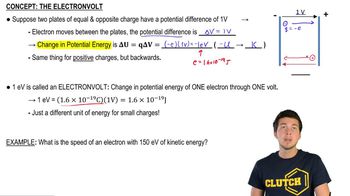
An electron volt is the change in potential energy of a charge (like an electron or proton) as it moves through a potential difference of one volt.
What equation relates potential energy change, charge, and potential difference?
The equation is ΔU = Q × ΔV, where ΔU is the change in potential energy, Q is the charge, and ΔV is the potential difference.
What is the value of the elementary charge (e) in coulombs?
The elementary charge is 1.6 × 10⁻¹⁹ coulombs.
How does an electron move between two plates with a potential difference of 1 volt?
An electron moves toward the plate with higher potential, experiencing a change in potential energy as it accelerates.
What happens to the potential energy of an electron as it moves through a potential difference?
The potential energy decreases and is converted into kinetic energy, causing the electron to speed up.
How does a positive charge (like a proton) behave in a potential difference?
A positive charge moves toward lower potentials, accelerating toward the negative plate and experiencing a similar energy conversion.
What is the change in potential energy for a proton moving through a -1 volt potential difference?
The change in potential energy is -1 eV, indicating energy is converted to kinetic energy as the proton accelerates.
What is the precise definition of 1 electron volt?
1 electron volt is the energy gained or lost by a single electron (or proton) moving through a potential difference of 1 volt.
Why is the electron volt a useful unit in physics?
It is convenient for measuring energy changes involving very small charges, such as electrons and protons.
How do you convert electron volts to joules?
Multiply the number of electron volts by 1.6 × 10⁻¹⁹ to get the energy in joules.
What formula is used to calculate the speed of an electron given its kinetic energy?
The formula is KE = ½ m v², where KE is kinetic energy, m is mass, and v is velocity.
What is the mass of an electron in kilograms?
The mass of an electron is 9.11 × 10⁻³¹ kilograms.
If an electron has 150 eV of kinetic energy, what is this energy in joules?
150 eV is equal to 2.4 × 10⁻¹⁷ joules.
What is the final speed of an electron with 150 eV of kinetic energy?
The final speed is 7.26 × 10⁶ meters per second.
Do energy equations change when using electron volts instead of joules?
No, all energy equations work the same; electron volts are simply a different unit of measurement.
 BackBack
 05:37
05:37