Skip to main content
Physics with Calculus
My Course
Learn
Exam Prep
AI Tutor
Study Guides
Textbook Solutions
Flashcards
Explore
Try the app
My Course
Learn
Exam Prep
AI Tutor
Study Guides
Textbook Solutions
Flashcards
Explore
Try the app
Back
Jumping Into/Out of Moving Disc quiz
You can tap to flip the card.
What is the moment of inertia for a solid disc of mass m and radius r?
You can tap to flip the card.
👆
What is the moment of inertia for a solid disc of mass m and radius r?
The moment of inertia for a solid disc is I = (1/2) m r^2.
Track progress
Control buttons has been changed to "navigation" mode.
1/15
Related flashcards
Related practice
Recommended videos
Jumping Into/Out of Moving Disc definitions
Jumping Into/Out of Moving Disc
15 Terms
Jumping Into/Out of Moving Disc
16. Angular Momentum
4 problems
Topic
Emilee
Spinning on String of Variable Length
16. Angular Momentum
1 problem
Topic
Emilee
16. Angular Momentum - Part 1 of 2
7 topics
16 problems
Chapter
Patrick
16. Angular Momentum - Part 2 of 2
1 topic
3 problems
Chapter
Guided course
14:28
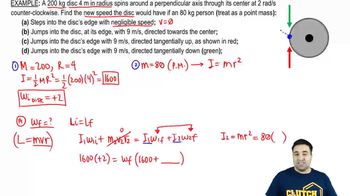
Jumping into a moving disc
3662
views
23
rank
Terms in this set (15)
Hide definitions
What is the moment of inertia for a solid disc of mass m and radius r?
The moment of inertia for a solid disc is I = (1/2) m r^2.
If a person steps onto a spinning disc with negligible speed, how does this affect the disc's angular speed?
The disc's angular speed decreases because the total moment of inertia increases, but no additional angular momentum is added.
What principle is used to solve angular collision problems involving a disc and a person jumping onto it?
The conservation of angular momentum is used, where the total initial angular momentum equals the total final angular momentum.
How do you calculate the moment of inertia for a point mass at the edge of a disc?
The moment of inertia for a point mass is I = m r^2, where m is the mass and r is the distance from the axis.
When a person jumps onto a disc at its edge with velocity directed toward the center, what is their contribution to angular momentum?
Their contribution is zero because the velocity is radial and does not cause rotation.
What is the effect on the disc's angular speed if a person jumps tangentially in the same direction as the disc's rotation?
The disc's angular speed increases, but the increase is small because the added mass also increases the moment of inertia.
What happens to the disc's angular speed if a person jumps tangentially against the direction of rotation?
The disc's angular speed decreases significantly, as the person adds negative angular momentum and increases the moment of inertia.
Why does adding mass to a rotating disc always slow it down if no extra angular momentum is added?
Because the moment of inertia increases while the total angular momentum remains the same, resulting in a lower angular speed.
How do you express the conservation of angular momentum for a disc and a person jumping onto it?
I_disc * ω_initial + m_person * v_person * r = (I_disc + I_person) * ω_final.
If a person jumps onto a disc with a tangential velocity, how do you determine the sign of their velocity in the angular momentum equation?
The sign is positive if the velocity is in the same direction as the disc's rotation and negative if it is opposite.
What is the final angular speed if a person jumps onto a spinning disc with negligible speed at the edge?
The final angular speed is lower than the initial and is calculated by dividing the initial angular momentum by the new total moment of inertia.
Why does jumping tangentially against the disc's rotation cause a larger change in angular speed than jumping with the rotation?
Because you both add negative angular momentum and increase the moment of inertia, causing a greater reduction in angular speed.
What is the formula for the angular momentum of a point mass moving linearly at a distance r from the axis?
The angular momentum is L = m v r, where v is the tangential velocity.
After a person lands on a disc, what is true about their angular speed relative to the disc?
They rotate together, so their angular speeds are equal.
If a person jumps onto a stationary disc tangentially, what happens to the disc?
The disc begins to rotate in the direction of the person's jump due to the angular momentum imparted by the person.
 BackBack

 14:28
14:28