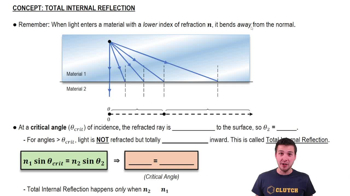
Total internal reflection occurs when light is completely reflected inside a material instead of refracting, typically when moving from a higher to a lower index of refraction.
When does total internal reflection occur?
It occurs when light passes from a material with a higher index of refraction to one with a lower index and the angle of incidence exceeds the critical angle.
What happens to light as it passes from a higher to a lower index of refraction?
The light bends away from the normal as it refracts.
What is the critical angle in total internal reflection?
The critical angle is the angle of incidence at which the refracted ray is parallel to the boundary between two materials.
How is the critical angle defined in terms of the refracted ray?
At the critical angle, the refracted ray makes a 90-degree angle with the normal, meaning it travels along the boundary.
What happens to light rays with angles greater than the critical angle?
They are totally reflected back into the material, rather than refracted.
What equation is used to calculate the critical angle?
The critical angle is calculated using theta critical = sin inverse (n2/n1).
What condition must be met for total internal reflection to occur?
Total internal reflection only occurs when n2 is less than n1, meaning the light moves from a higher to a lower index of refraction.
What is the value of sine of 90 degrees used in the critical angle calculation?
The sine of 90 degrees is 1.
What happens to the refracted ray at the critical angle?
The refracted ray becomes perfectly parallel to the surface, making a 90-degree angle with the normal.
What is the critical angle for light moving from glass (n1 = 1.46) to air (n2 = 1.0)?
The critical angle is 43.2 degrees.
How do you know if the critical angle equation is applicable?
The equation is only applicable if n2 is less than n1.
What happens to light rays with angles less than the critical angle?
They are refracted into the second material.
What does Snell's Law state for the critical angle scenario?
Snell's Law gives the critical angle when the refracted angle is 90 degrees, leading to the formula theta critical = sin inverse (n2/n1).
What is the physical significance of total internal reflection?
It allows light to be completely reflected within a material, which is used in applications like fiber optics.